
Powerful Motor: 5,5 HP / 4 kW Gearmotor
Speed Control: Inverter
Strong Construction: SUS304 shaft & 3-level umbrella impeller (Ø400 mm) mirror polish
Smart Control Panel: RPM Display, Amperemeter, Rotary Lamp, Timer, Emergency Stop
Easy Operation: Electrical Winch/Hoist (max. 300 kg, 220V)
Mobile Frame: Heavy-duty square pipe with PU Castor Wheels
Ideal for mixing applications in IBC tank or drum – durable, efficient, and user-friendly.
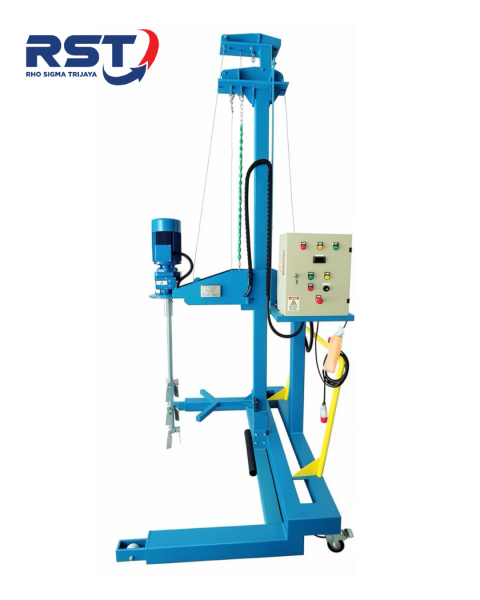
An Intermediate Bulk Container (IBC) Mixer is a compact and portable industrial mixing machine designed to mix, blend, and maintain liquid homogeneity directly inside an IBC tote. It provides an efficient solution for manufacturers who need to mix liquids, maintain product consistency, or resuspend settled solids without transferring materials into a separate mixing tank.
IBC mixers are widely used in industries such as chemical processing, paint and coatings, printing ink, agrochemicals, food and beverage, and pharmaceutical manufacturing. By allowing mixing directly inside the container, an IBC mixer can simplify material handling, reduce additional transfer operations, and improve production flexibility.
Engineered and manufactured by PT Rho Sigma Trijaya (RST), the RST IBC Tote Mixer is designed to provide a practical and flexible mixing solution for industrial applications. The equipment can be configured with electric or pneumatic drives, different impeller designs, and customized mounting arrangements to accommodate specific material characteristics and production requirements.
Whether the objective is to maintain liquid homogeneity, blend compatible liquid ingredients, or resuspend settled particles, the RST IBC Mixer can be configured to support different industrial mixing processes.
An IBC Tote Mixer operates by rotating an impeller inside the liquid material to generate fluid movement and circulation.
The drive unit transfers rotational power through a shaft to the impeller, creating fluid flow inside the IBC container.
For applications requiring a compact installation, a folding impeller can be used. The blades remain folded during insertion through the container opening and expand into their operating position when the mixer starts rotating, depending on the impeller design.
The general operating process involves the following steps:
Installation: Position the mixer on the IBC container using the appropriate mounting arrangement.
Impeller insertion: Insert the shaft and impeller through the IBC filling opening.
Drive connection: Connect the electric or pneumatic drive according to the equipment configuration.
Mixing operation: Start the mixer at the recommended rotational speed to generate liquid circulation and blending.
Process monitoring: Monitor mixing performance, operating conditions, and product consistency.
Removal: Stop the mixer before removing the equipment from the container.
The required mixing time and rotational speed depend on liquid viscosity, density, container geometry, impeller design, and the intended mixing objective.
The RST IBC Mixer is designed to provide operational flexibility for manufacturers using IBC containers in their production processes.
The mixer operates directly inside the IBC tote, eliminating the need to transfer materials into a separate mixing vessel for compatible applications.
This can simplify production workflows and reduce additional material handling operations.
The compact configuration allows the equipment to be installed and removed when required. This is particularly beneficial for production facilities that use multiple IBC containers for different products or batches.
RST IBC Mixers can be configured with:
Electric motor drive.
Pneumatic motor drive.
The selection depends on process requirements, available utilities, operating environment, and applicable safety requirements.
A folding impeller design can be selected for applications where the mixer must pass through a relatively small IBC filling opening.
The folding blades are designed to expand into their operating position during rotation. Final impeller configuration depends on the container opening and mixing requirements.
The impeller generates fluid circulation to support liquid blending and product homogeneity.
The mixing performance depends on the selected impeller geometry, rotational speed, liquid viscosity, and IBC dimensions.
Because mixing takes place directly inside the IBC container, additional transfer to a separate mixing tank may be avoided.
Fewer transfer operations can also help reduce material handling requirements and potential contamination points.
RST can customize the mixer configuration according to specific application requirements, including drive type, impeller design, shaft arrangement, and mounting configuration.
The following table outlines the main engineering parameters that can be considered when configuring an IBC mixing system.
| Parameter | Available Configuration / Description |
|---|---|
| Equipment Type | Intermediate Bulk Container Mixer |
| Application | Direct mixing inside IBC totes |
| Drive System | Electric Motor / Pneumatic Motor |
| Impeller Type | Folding Impeller / Application-Specific Impeller |
| Shaft Design | Customized according to IBC dimensions |
| Mounting System | IBC Top-Mounted Arrangement |
| Mixing Function | Liquid Blending, Circulation, Homogeneity Maintenance, Solid Resuspension |
| Material of Construction | Selected according to product compatibility |
| Rotational Speed | Determined by process requirements |
| Motor Power | Selected according to viscosity, volume, and mixing duty |
| Container Compatibility | Subject to IBC opening, dimensions, and mounting arrangement |
| Design | Custom Engineered by RST |
Note: Final specifications, including motor power, RPM, shaft dimensions, impeller diameter, and construction material, are determined through engineering evaluation based on the customer's application. Not all configurations are suitable for every IBC container.
An IBC Mixer is used to mix liquids directly inside an Intermediate Bulk Container (IBC) tote. Its main functions include liquid blending, maintaining product homogeneity, generating liquid circulation, and resuspending settled solids without transferring materials to a separate mixing tank.
Yes. An IBC mixer is specifically designed to mix liquids directly inside an IBC container. The mixer is installed through the filling opening and operates using a rotating impeller to generate fluid circulation.
IBC mixers can be used for compatible liquid materials such as industrial chemicals, paint, coatings, printing ink, agrochemical formulations, and selected food and pharmaceutical liquids. Material viscosity, density, chemical compatibility, and mixing requirements must be evaluated before selecting the equipment.
IBC mixers are generally more suitable for low to medium-viscosity liquids. High-viscosity materials may require higher torque, specialized impeller designs, or dedicated industrial mixing systems. Engineering evaluation is necessary before determining suitability.
A folding impeller is a specially designed mixing blade that can fold during insertion through the IBC filling opening and expand into its operating position during rotation. This design allows the mixer to be installed through a relatively small container opening.
Both options have different advantages. Electric motors are suitable for facilities with an appropriate electrical power supply, while pneumatic motors operate using compressed air and may be preferred in certain operating environments. The final selection depends on process conditions, available utilities, and safety requirements.
An IBC mixer can help resuspend settled solids and maintain suspension during operation. However, the effectiveness depends on particle size, solid concentration, density difference, liquid viscosity, impeller design, and mixing speed. Some formulations may require continuous agitation or specialized mixing configurations.
SUS304 and SUS316L are commonly considered for industrial mixing equipment. SUS304 is suitable for many general industrial applications, while SUS316L may be preferred for applications requiring improved resistance to certain corrosive environments. The final selection must be based on chemical compatibility and operating conditions.
Yes. An IBC mixer can be customized according to the customer's process requirements. Customization may include motor type, motor power, rotational speed, shaft length, impeller diameter, impeller design, mounting arrangement, and construction material.
The main information required includes IBC capacity and dimensions, liquid viscosity, material density, chemical composition, operating temperature, mixing objective, and available power supply. These parameters help determine the appropriate motor, shaft, impeller, and overall mixer configuration.
An IBC mixer is designed to operate directly inside an IBC tote, while a conventional tank mixer is installed on a dedicated mixing vessel. IBC mixers offer portability and flexibility, whereas conventional tank mixers can be designed for larger capacities and more complex production processes.
PT Rho Sigma Trijaya (RST) is an Indonesian manufacturer of custom industrial mixing equipment, including IBC mixers, High Speed Dispersers, Ribbon Mixers, and Industrial Agitators. RST provides engineering and manufacturing solutions based on specific customer applications and production requirements.
Are you looking for an efficient way to mix liquids directly inside your IBC container?
PT Rho Sigma Trijaya provides custom-engineered IBC Mixer solutions designed to support industrial liquid mixing, blending, and product homogeneity maintenance.
Whether you require an electric or pneumatic drive, folding impeller, or application-specific mixing configuration, our engineering team can help determine the right solution for your process.
Contact PT Rho Sigma Trijaya today to discuss your IBC mixing requirements and request a technical consultation.
Website: https://rhosigmatrijaya.co.id/
Email: sales1@rhosigmatrijaya.co.id
PT Rho Sigma Trijaya – Industrial Mixing Solutions & Custom Manufacturing.

RST Air Mixer with pneumatic drive for industrial mixing in hazardous environments. Ideal for paint, ink, adhesives, and solvent-based chemical processing.
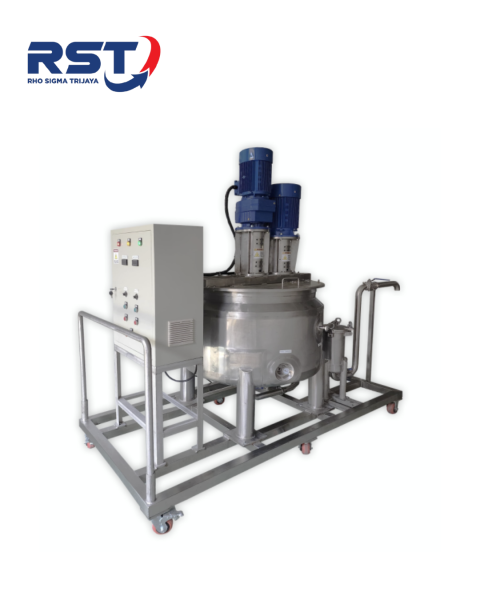
RST Pilot Mixer for process development, formulation testing, and production scale-up. Custom pilot mixing solutions for paint, chemical, adhesive, cosmetic, and pharma industries.

RST Jet Stream Mixer for fast mixing, homogenization, and disintegration. Available in inline and top-entry configurations, customized for industrial applications.
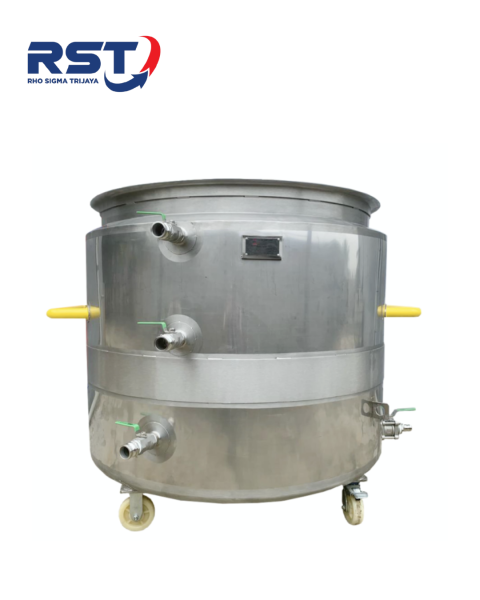
Custom Double Jacket Tanks from 100–20,000 liters for heating and cooling applications. Stainless steel tanks with mixer options for chemical, food, pharma, and adhesive industries.


