Jet Stream Mixer Material Kental
mixer material kental, high viscosity mixer, mesin pengaduk industri, mixing tanpa pemanasan, mixer glukosa, industrial mixing equipment
Jet Stream Mixer: A Solution for High-Viscosity Mixing Without Heating in Industrial Applications
PT Rho Sigma Trijaya (RST) | Industrial Mixing Equipment Manufacturer
Introduction
Mixing is a critical process in many manufacturing industries. The quality of mixing can affect product uniformity, production efficiency, energy consumption, processing time, and final product consistency.
However, not all materials are easy to mix. High-viscosity liquids, concentrated syrups, thick chemical formulations, adhesives, resins, and other industrial materials can present significant mixing challenges. These materials may be difficult to circulate, require high starting torque, or resist uniform blending with conventional mixing equipment.
In some applications, heating is used to reduce viscosity and improve material flow. Although heating can be effective, it also requires additional energy, temperature control, and supporting equipment.
A Jet Stream Mixer is a mixing technology that can be evaluated for applications requiring directed fluid flow, improved circulation, and efficient material blending. For suitable applications, it may support mixing and dilution processes without the need for dedicated heating.
PT Rho Sigma Trijaya (RST) provides industrial mixing equipment designed around specific process requirements, material characteristics, production capacity, and installation conditions.
This article explores how Jet Stream Mixer technology works, its potential industrial applications, energy efficiency considerations, engineering design parameters, and a practical example involving the dilution of 85° Brix glucose syrup without heating.
1. What Is a Jet Stream Mixer?
A Jet Stream Mixer is industrial mixing equipment designed to generate directed fluid flow to promote material movement and mixing inside a tank or vessel.
Rather than focusing solely on impeller rotational speed, the design must consider how mechanical energy from the motor is converted into effective fluid circulation.
The objective is to move material beyond the immediate area surrounding the impeller, improve the distribution of added ingredients, and reduce poorly circulated zones within the vessel.
Actual performance depends on impeller geometry, diameter, rotational speed, fluid properties, vessel geometry, and mixer positioning.
Jet Stream Mixers can be evaluated for applications such as:
Diluting high-viscosity liquids with water or other compatible liquids.
Blending two or more liquid components.
Improving material circulation inside tanks and drums.
Supporting homogenization of suitable liquid formulations.
Mixing food and beverage ingredients.
Processing selected chemical, adhesive, resin, and industrial formulations.
The appropriate configuration must be determined by the actual process requirements. A design that performs well with one material may not produce the same results with another material that has different flow characteristics.
2. Why Is High-Viscosity Mixing Challenging?
Viscosity is one of the most important parameters when selecting industrial mixing equipment.
High-viscosity materials generally resist movement more strongly than low-viscosity liquids. As a result, circulation inside the mixing vessel may become limited, making the process more demanding.
Common challenges include the following.
A. Uneven Material Circulation
Material may move effectively near the impeller while other areas of the vessel experience insufficient circulation. This can result in inconsistent mixing.
B. Higher Torque Requirements
The greater the resistance to impeller movement, the more important it becomes to select a suitable motor, gearbox, shaft, and mechanical components.
C. Longer Mixing Time
Poor circulation can increase the time required to achieve the desired degree of uniformity.
D. Difficult Dilution
When water is added to a viscous liquid, it may initially mix within a limited area. Effective circulation is needed to distribute the added liquid throughout the batch.
E. Inefficient Energy Consumption
A higher motor rating does not automatically produce a more efficient process. Performance should be evaluated based on mixing quality, operating time, and total energy consumption.
For these reasons, mixer selection should consider material properties, process objectives, flow patterns, torque requirements, and the required final product quality.
3. How Does a Jet Stream Mixer Improve Circulation?
A Jet Stream Mixer uses mechanical energy to generate fluid movement that supports the mixing process.
In a top-entry configuration, the mixer is installed from the top of the tank or drum. The impeller design and installation position influence how material moves throughout the vessel.
Several engineering factors are particularly important.
Fluid Circulation
The generated flow should help transport material from one area to another. Effective circulation can improve the distribution of added ingredients and reduce poorly mixed regions.
Pumping Flow
Pumping flow describes the ability of the impeller system to move a volume of fluid. It is different from simply producing a high local fluid velocity near the impeller.
For dilution applications, the ability to circulate material throughout the vessel may be more important than achieving high velocity at a single location.
Impeller Geometry
Impeller diameter, blade shape, blade angle, and flow configuration influence mixer performance.
The appropriate impeller must be selected according to the material, viscosity, vessel dimensions, circulation requirements, and available power.
Impeller Position
The distance between the impeller and the tank bottom, walls, and liquid surface can influence the resulting flow pattern.
An impeller positioned too close to or too far from the bottom does not necessarily provide the best performance. The optimum position should be evaluated according to the impeller geometry, vessel shape, and material properties.
Rotational Speed
RPM affects flow characteristics, power demand, and mechanical loading. However, increasing rotational speed does not always improve mixing efficiency proportionally.
A suitable design should balance pumping flow, torque, motor power, and mixing quality.
4. Can a Jet Stream Mixer Operate Without Heating?
For selected applications, a Jet Stream Mixer can support mixing or dilution without dedicated heating.
This approach is particularly relevant when the process objective is to blend materials or reduce their concentration by adding another liquid, rather than performing a treatment that specifically requires elevated temperatures.
For example, a concentrated liquid may be diluted with water. As the concentration decreases, the viscosity of the resulting mixture may also decrease, depending on the material composition and its flow characteristics.
Under suitable conditions, this approach may eliminate the need for a separate heating step.
Potential benefits include:
Reduced energy requirements for heating.
Simplified process equipment configuration.
Reduced temperature-control requirements where heating is unnecessary.
Support for dilution at lower operating temperatures.
Opportunities to optimize total processing time and operating costs.
However, mixing without heating is not suitable for every material. Certain products may require elevated temperatures to achieve the necessary solubility, viscosity, or final product characteristics.
Process feasibility should therefore be established through engineering evaluation and application testing.
5. Industrial Applications of Jet Stream Mixers
Jet Stream Mixers can be evaluated for a variety of industrial applications requiring mixing, dilution, or improved material circulation.
Suitability depends on viscosity, composition, operating temperature, process objectives, and equipment design.
A. Food and Beverage Industry
Food and beverage manufacturers use a wide range of ingredients, from low-viscosity liquids to highly concentrated syrups.
Potential materials for evaluation include:
Glucose syrup.
Sugar syrup.
Sugar solutions.
Palm sugar syrup.
Liquid food ingredients.
Other viscous liquids requiring dilution.
In these applications, a mixer may help distribute added water, blend ingredients, and improve circulation inside a vessel.
For food applications, product-contact materials, hygiene, cleanability, and applicable sanitary requirements must be included in the equipment specification.
B. Chemical Industry
Chemical manufacturing involves mixing processes with different requirements for uniformity, flow characteristics, and process control.
Potential applications include chemical solutions, liquid raw materials, and selected formulations requiring dilution or circulation.
Mixer selection must consider material compatibility, corrosiveness, operating temperature, and process safety requirements.
C. Paint and Ink Industry
Mixing is an important part of paint and ink formulation.
Some processes involve blending resins, binders, solvents, pigments, and other ingredients. However, blending, dissolution, pigment dispersion, and homogenization are different operations.
A Jet Stream Mixer may be evaluated for suitable blending and circulation applications. It does not automatically replace a high-speed disperser when high shear is required to break down pigment agglomerates.
Equipment selection should follow the actual process objective and final product requirements.
D. Adhesive and Sealant Industry
Adhesives and sealants can range from relatively free-flowing liquids to highly viscous materials.
In selected applications, material circulation is a significant process challenge. Mixer design must consider torque requirements, rheological behavior, processing time, and temperature sensitivity.
Very viscous or non-Newtonian formulations require application testing before a final configuration is selected.
E. Resin and Polymer Raw Materials
Certain resin formulations require blending, dilution, or homogenization before the next production stage.
A Jet Stream Mixer may be evaluated for processes that are compatible with its circulation capability and the material's flow characteristics.
Materials that cure, react chemically, or require specific processing temperatures need additional evaluation.
F. Building Materials Industry
Building materials manufacturing may involve liquid or semi-liquid raw materials used in industrial formulations.
Examples include liquid binders, additives, and selected construction chemical formulations.
Mixer selection should consider viscosity, sedimentation potential, material compatibility, and the required degree of uniformity.
G. Industrial Raw Material Processing
Jet Stream Mixers can also be evaluated for liquid raw materials requiring dilution and circulation before entering subsequent production stages.
For every application, process suitability and performance should be verified using the actual material and operating conditions.
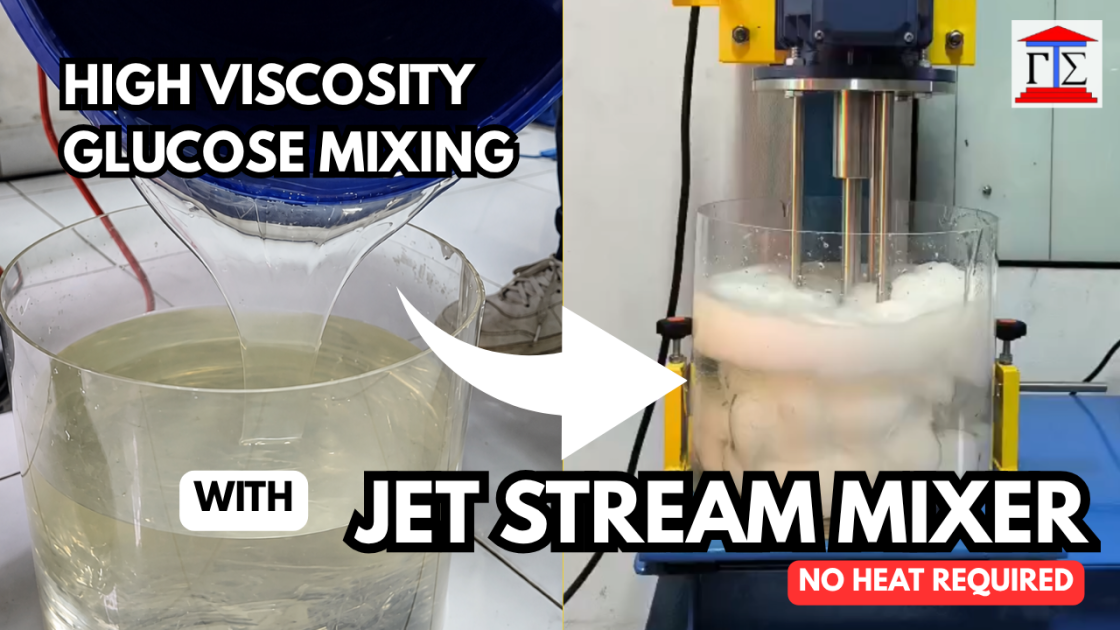
6. Case Study: Mixing 85° Brix Glucose Without Heating
A relevant application is the dilution of glucose syrup with an initial concentration of 85° Brix.
Highly concentrated glucose syrup can exhibit substantial viscosity, making it difficult to transfer and mix uniformly at lower temperatures.
Conventional processes may use heating to reduce viscosity. However, when the primary objective is to dilute glucose with water, a no-heating approach may be worth evaluating.
Process Challenges
Important considerations include:
High initial glucose viscosity.
The need for material circulation inside a drum or tank.
Water distribution during addition.
Motor starting torque requirements.
Target final Brix.
Mixing time and final uniformity.
Using a Jet Stream Mixer
A Jet Stream Mixer can be designed to promote material movement and distribute added water throughout the vessel.
The design should consider impeller diameter, flow geometry, RPM, torque requirements, vessel capacity, and installation position.
The water addition method is also important. Gradual addition at an appropriate location may support the dilution process, depending on the material properties and resulting circulation pattern.
Example of a Dilution Calculation
Assume one part of 85° Brix glucose syrup is mixed with two parts of water by mass.
Assuming the initial syrup contains 85% soluble solids by mass, the water contains no dissolved solids, and there are no material losses, the theoretical final concentration is:
Final Brix = (85 × 1) / (1 + 2)
Final Brix ≈ 28.3° Brix.
This is a theoretical mass-balance estimate. The actual result must be verified through Brix measurement and product testing.
This calculation does not determine the required motor power or mixing time. Those parameters must be established through engineering evaluation and application testing.
Performance Verification
A practical trial should record:
Initial and final Brix.
Glucose and water quantities.
Initial and final temperatures.
Mixer RPM.
Actual electrical power consumption.
Total mixing time.
Sample uniformity at multiple locations.
Motor and gearbox operating conditions.
These measurements help establish whether the dilution process can achieve the desired result without dedicated heating.
7. Factors That Determine Jet Stream Mixer Efficiency
Mixing efficiency cannot be evaluated solely by rotational speed or motor rating.
An efficient mixer should achieve the required process result within a reasonable time, with acceptable product quality and measurable energy consumption.
Impeller Design
The impeller must match the process objective. A design intended for circulation may differ significantly from one intended for dispersion or highly viscous mixing.
Power and Torque Requirements
The motor and gearbox must be selected according to the actual load. An undersized drive may experience starting difficulties or overload, while an oversized drive without proper engineering justification may increase capital costs.
Mixing Time
Mixing time should be measured until the product meets defined uniformity criteria, rather than being based solely on visual observation.
Energy Consumption
Total energy per batch can be calculated from actual power consumption during operation. If heating is involved, heating energy must also be included for a fair comparison.
Reduction of Additional Processing Steps
If heating or other process stages can be eliminated, potential savings can be evaluated through changes in energy use, processing time, and equipment requirements.
Product Consistency
Efficiency improvements must not compromise final product quality. A shorter mixing time is not beneficial if the product fails to meet its specifications.
8. Comparing Jet Stream Mixers with Other Mixing Technologies
No single mixer is ideal for every industrial application. Selection should be based on material properties and process objectives.
Jet Stream Mixer
Can be evaluated for applications requiring directed flow, material circulation, and selected dilution processes.
High-Speed Disperser
Commonly used when high shear is required to wet and disperse solid particles, such as pigments in paint formulations.
Propeller Mixer
Often used for relatively low-viscosity liquids requiring circulation or blending.
Anchor Mixer
Can be suitable for higher-viscosity materials, particularly when material movement near the vessel wall is important. The appropriate design depends on fluid behavior and process requirements.
Ribbon Mixer
Generally used for blending powders and granular materials in suitable vessels.
These technologies serve different purposes. Jet Stream Mixer selection should therefore be based on the actual application rather than a simple comparison of RPM or motor power.
9. Engineering Parameters for Jet Stream Mixer Selection
Before finalizing a design, several categories of process information should be collected.
Material Data
Material type and composition.
Viscosity at operating temperature.
Material density.
Initial and target concentrations.
Temperature sensitivity.
Corrosive or reactive properties, where applicable.
Vessel Data
Total and working volume.
Tank diameter and height.
Bottom geometry.
Mixer installation position.
Opening dimensions and installation limitations.
Operating Data
Target mixing time.
Required or maximum RPM.
Pumping flow requirements.
Operating temperature.
Ingredient addition method.
Required product uniformity.
Mechanical and Electrical Data
Motor power.
Torque requirements.
Gearbox type.
Shaft dimensions and strength.
Seal type.
Electrical supply and control system.
These details help determine whether a Jet Stream Mixer is suitable for the intended application and which performance parameters require validation before production.
10. How to Verify Energy Savings
Energy-saving claims should be supported by relevant measurements.
When comparing heated and non-heated processes, use equivalent batch sizes, target product specifications, and quality criteria.
Record energy consumption from the heater, mixer, pump, and other supporting equipment. Then calculate the total energy required until the product meets its specifications.
A simple electrical energy calculation is:
Energy (kWh) = Actual Power (kW) × Operating Time (hours).
For equipment with variable power consumption, use actual power data throughout the process or direct energy measurements.
The percentage of energy savings can be calculated as:
Energy Savings (%) = [(Baseline Energy − New Process Energy) / Baseline Energy] × 100%.
The comparison must include the entire process. If the non-heated process requires substantially longer mixing, eliminating heating may not translate into an equivalent reduction in total energy consumption.
This approach helps manufacturers evaluate potential equipment investments using measurable operating data rather than assumptions.
11. Why Choose Customized Mixing Solutions from RST?
PT Rho Sigma Trijaya (RST) is an industrial mixing equipment manufacturer providing solutions based on customer process requirements.
Every application has different characteristics. Mixer design should therefore reflect the material, production volume, process objectives, and installation conditions.
For Jet Stream Mixer applications, the engineering evaluation may include:
Material properties and viscosity.
Tank or drum capacity.
Circulation and mixing objectives.
Motor and gearbox requirements.
Impeller geometry and installation position.
Suitable construction materials.
Cleaning and maintenance requirements.
Operating conditions and safety considerations.
RST can help evaluate application requirements and identify the engineering parameters that need further development.
For highly viscous, non-Newtonian, reactive, or process-sensitive materials, application testing is an important step before finalizing the equipment specification.
12. Jet Stream Mixer Demonstration Videos
Demonstration videos help potential customers understand the equipment and observe the mixing application directly.
Mixing Process Demonstration
Watch the following mixing demonstration:
When embedding the videos on the website, include captions that accurately describe the material, operating conditions, and results shown in each demonstration.
Additional documentation, such as before-and-after mixing photographs, temperature readings, Brix measurements, mixing duration, and energy consumption, can strengthen the technical value of the article.
13. Frequently Asked Questions About Jet Stream Mixers
What is a Jet Stream Mixer used for?
A Jet Stream Mixer is used to support mixing and material circulation through directed fluid flow. Its suitability depends on the material properties and process objectives.
Can a Jet Stream Mixer handle high-viscosity materials?
It can be evaluated for selected applications, but the design must consider viscosity, torque, impeller geometry, vessel capacity, and circulation performance.
Can a Jet Stream Mixer mix 85° Brix glucose without heating?
This may be feasible for selected dilution applications. Performance must be verified through testing that considers temperature, water ratio, viscosity, and target product characteristics.
Can a Jet Stream Mixer be used in the food and beverage industry?
It can be evaluated for various mixing and dilution applications. Product-contact materials, hygiene, cleanability, and applicable sanitary requirements must be included in the equipment specification.
Is a Jet Stream Mixer suitable for paint and ink manufacturing?
Suitability depends on the process. It may be evaluated for blending and circulation, while pigment dispersion requiring high shear may need a high-speed disperser or another suitable system.
Can a Jet Stream Mixer reduce production costs?
Potentially, if the process can be optimized in terms of energy consumption, mixing time, or equipment requirements. Actual savings must be calculated using operating data.
How is the required motor power determined?
Motor power is determined by torque requirements, RPM, material properties, impeller design, and operating conditions. Engineering calculations and application validation are recommended.
Does RST provide customized mixing equipment?
PT Rho Sigma Trijaya can evaluate customer applications and develop mixing solutions based on material specifications, production capacity, process objectives, and installation conditions.
Conclusion
A Jet Stream Mixer is a mixing solution that can be evaluated to improve circulation and support material blending across a range of industrial applications.
For suitable processes, this technology may support high-viscosity material dilution without dedicated heating, simplify equipment configuration, and create opportunities to optimize processing time and energy consumption.
However, successful mixing depends on more than rotational speed or motor power. Impeller design, torque requirements, material viscosity, vessel geometry, ingredient addition methods, and final product specifications must all be considered.
The example of mixing 85° Brix glucose demonstrates how Jet Stream Mixer technology can be evaluated for dilution without heating. The same engineering approach can be applied to other materials, provided their individual characteristics and process requirements are taken into account.
PT Rho Sigma Trijaya (RST) provides industrial mixing solutions tailored to manufacturing process requirements.
To discuss Jet Stream Mixer applications for high-viscosity liquids, syrups, chemicals, adhesives, or other industrial materials, contact the RST team.
Website: https://www.rhosigmatrijaya.co.id/
Jet Stream Mixer Product Page: https://rhosigmatrijaya.co.id/jet-stream-mixer
Email: sales1@rhosigmatrijaya.co.id
PT Rho Sigma Trijaya — Customized Industrial Mixing Solutions.