Perbedaan Mixing, Agitation, dan Dispersion dalam Industri
perbedaan mixing, agitation, dan dispersion. cara memilih mesin mixer industri. mesin mixing untuk industri kimia. kapan menggunakan High Speed Disperser. perbedaan agitator dan High Speed Disperser. mesin mixer industri. mesin mixing industri kimia. industrial agitator. High Speed Disperser. HSD Mixer. mesin pengaduk cairan industri. mesin dispersi industri. fungsi mixing dan agitation.
Mixing, Agitation, and Dispersion: Understanding the Processes and Choosing the Right Industrial Mixer
In the chemical industry, selecting the right mixing equipment involves more than considering tank capacity or motor power. Material properties, viscosity, process objectives, and desired product quality all influence the equipment configuration required.
Three terms commonly used in industrial processing are mixing, agitation, and dispersion. Although they are closely related, each describes a different process objective and may require a different mixing solution.
Understanding these differences helps Engineering, Production, and Purchasing/Procurement teams identify suitable equipment before requesting quotations or comparing suppliers.
PT Rho Sigma Trijaya (RST) offers a range of industrial mixing solutions, including High Speed Disperser (HSD) Mixers, Industrial Agitators, Jet Stream Mixers, Ribbon Mixers, Laboratory Mixers, and IBC Mixers. Equipment selection should be based on material characteristics and actual process requirements.
1. Mixing: Combining Materials
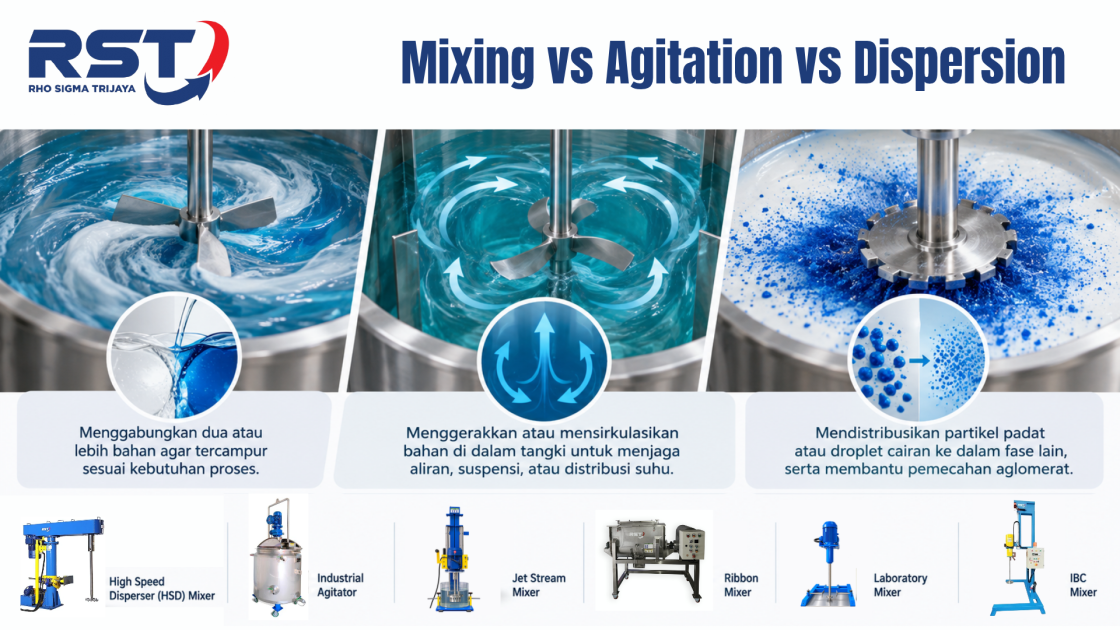
Mixing is the process of combining two or more materials to achieve the desired composition or distribution of components.
The materials may include liquid-liquid combinations, powders mixed with liquids, or other combinations that require a specific mixing process.
The objective depends on the material properties and the intended result. Some mixing processes aim to achieve a homogeneous mixture, while others focus on distributing ingredients evenly or supporting heat transfer.
Common industrial mixing applications
Mixing water with chemical solutions.
Dissolving additives into liquids.
Blending liquid raw materials for product formulations.
Mixing ingredients used in detergents, personal care products, and industrial chemicals.
Which RST equipment may be suitable?
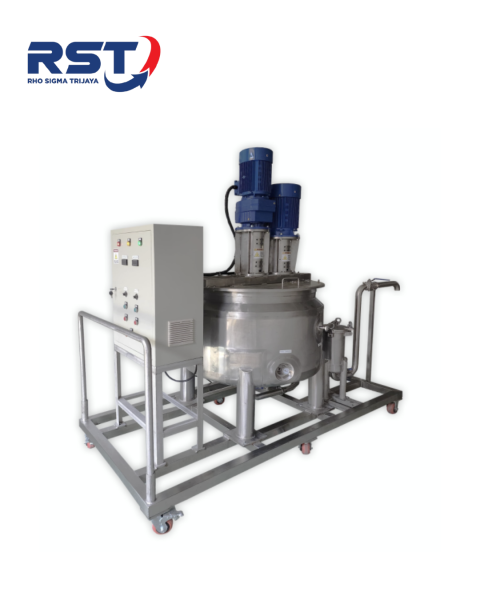
Industrial Agitator: For liquid mixing and circulation within tanks.
Jet Stream Mixer: For mixing and rapid homogenization in suitable applications.
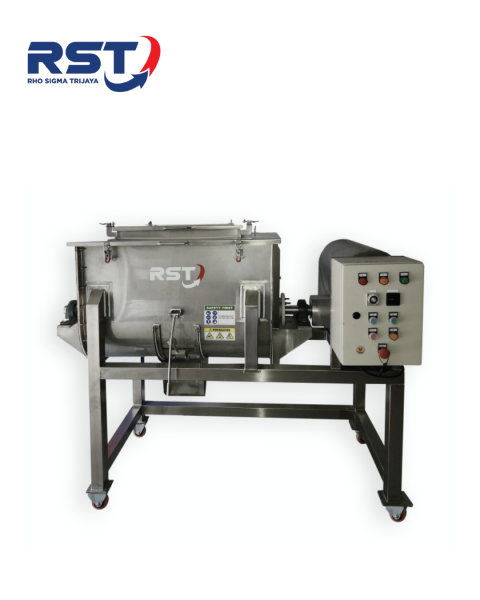
Ribbon Mixer: For blending powders, dry materials, and granules.
IBC Mixer: For mixing liquids directly inside IBC containers.
The appropriate equipment depends on material characteristics, working capacity, mixing time, and the required level of homogeneity.
For Procurement teams: Tank capacity alone is not sufficient to determine the right mixer. Viscosity, material behavior, mixing time, and product homogeneity requirements must also be considered.
2. Agitation: Creating Circulation and Material Movement
Agitation is the process of generating movement or circulation within a tank using an impeller or another mixing element.
Agitation is commonly used to keep materials moving, reduce particle settling, support heat transfer, or maintain material distribution during production.
Mixing and agitation are closely related. Agitation describes the mechanical action that generates flow, while mixing refers to the process objective or desired result.
Common industrial agitation applications
Keeping solid particles suspended in liquids.
Maintaining the uniformity of a solution during processing.
Supporting temperature distribution during heating or cooling.
Maintaining liquid circulation during chemical reactions.
Reducing the risk of temperature or concentration differences within a tank.
Which RST equipment may be suitable?
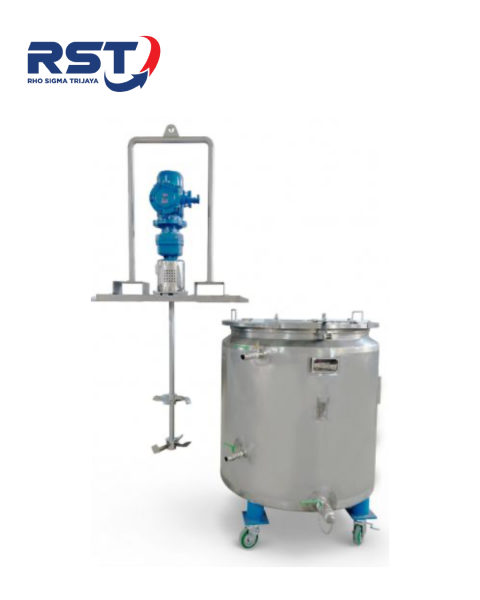
An Industrial Agitator with a Mixing Tank may be suitable when the process requires liquid agitation, homogenization, or circulation.
The equipment configuration can be evaluated based on tank capacity, motor power, rotational speed, impeller design, and material properties.
For applications primarily involving circulation or temperature distribution, a conventional agitator may be more appropriate than a high-speed machine designed for specific dispersion requirements.
For Procurement teams: If the main objective is circulation, particle suspension, or temperature uniformity, a high rotational speed is not necessarily required.
3. Dispersion: Distributing Particles in a Liquid
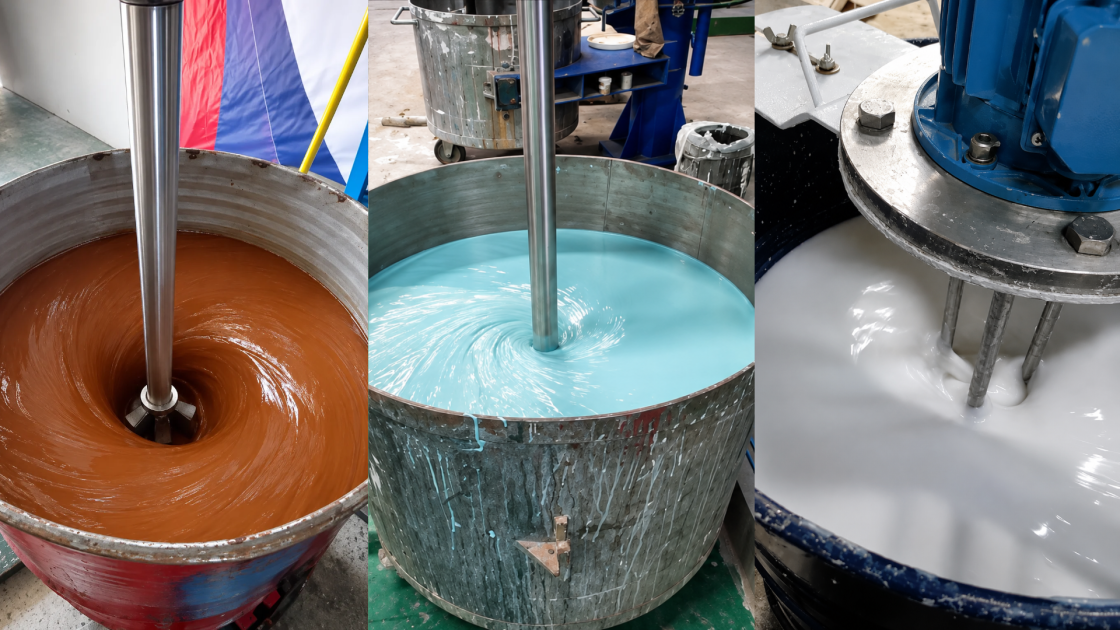
Dispersion is the process of distributing a material as particles or droplets within another phase.
In the chemical industry, dispersion is often required when solid materials such as pigments or fillers need to be distributed throughout a liquid. Depending on the application, the process may also involve breaking down agglomerates to achieve a more uniform particle distribution.
The required energy and equipment depend on the material, particle size, degree of agglomeration, viscosity, and desired dispersion quality.
Common industrial dispersion applications
Dispersing pigments in paints or inks.
Dispersing fillers into resins.
Wetting and distributing powders in liquids.
Processing coating formulations.
Preparing chemical formulations that require controlled particle distribution.
Which RST equipment may be suitable?
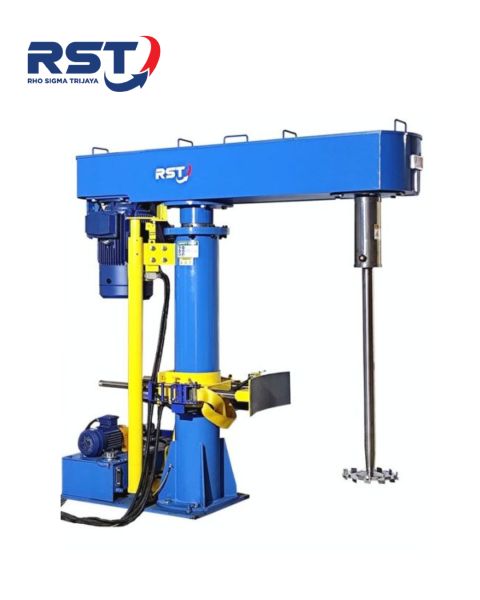
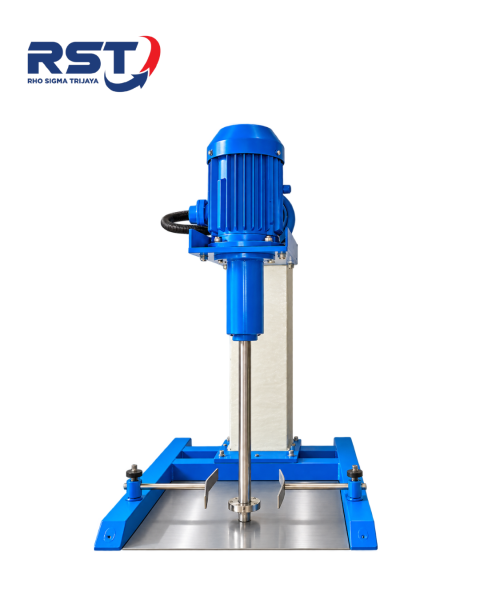
The High Speed Disperser (HSD) Mixer is designed for dispersion applications in which a high-speed impeller helps wet materials and break down agglomerates.
Potential applications include paint, ink, resin, coating, and other chemical formulations that require dispersion.
RST also offers the Jet Stream Mixer for mixing, homogenization, and rapid disintegration in applications suited to its equipment configuration and material characteristics.
These machines are not automatically interchangeable. Selection should consider viscosity, material properties, shear requirements, and the desired process outcome.
For Procurement teams: The term dispersion alone is not enough to determine the required machine. It is important to establish whether the process requires simple distribution, agglomerate breakup, or a specific particle-size and fineness target.
4. Understanding the Differences Between Mixing, Agitation, and Dispersion
Although these processes are related, they do not always require the same equipment.
| Aspect | Mixing | Agitation | Dispersion |
|---|---|---|---|
| Main focus | Combining and distributing materials | Moving or circulating materials | Distributing particles or droplets within another phase |
| General objective | Achieving the desired composition or homogeneity | Maintaining circulation, suspension, or heat distribution | Achieving the required dispersion quality |
| Example | Mixing two liquids | Keeping particles suspended | Dispersing pigments in paint |
| RST equipment to evaluate | Industrial Agitator, Jet Stream Mixer, Ribbon Mixer, or IBC Mixer, depending on the application | Industrial Agitator | HSD Mixer or Jet Stream Mixer, depending on the application |
| Key considerations | Viscosity and homogeneity | Flow pattern, suspension, and heat transfer | Agglomeration, particle distribution, viscosity, and required fineness |
Mixing, agitation, and dispersion are not completely separate categories. A single process may involve all three. For example, paint production may require agitation to maintain circulation, mixing to combine formulation ingredients, and dispersion to distribute pigments.
The appropriate equipment should therefore be selected according to the most critical process objective.
5. How to Choose the Right Industrial Mixing Equipment
Before requesting a quotation, Purchasing/Procurement teams should gather essential technical information about the application.
A. Identify the material characteristics
Determine whether the material is a liquid, powder, suspended solid, or a combination of phases.
Information such as viscosity, density, particle size, and the tendency to form agglomerates can help determine the required mixing configuration.
B. Define the process objective
Work with the Engineering or Production team to establish the intended result.
Does the material simply need to be blended uniformly?
Must solid particles remain suspended?
Is powder wetting and dispersion required?
Is there a specific particle-size or fineness target?
Does the process require heat transfer or temperature control?
The answers help narrow down the equipment options.
C. Consider tank capacity and geometry
Tank volume is important, but it is not sufficient to determine the equipment specification.
Tank diameter, liquid height, bottom geometry, impeller position, and the presence of baffles can influence flow patterns and mixing performance.
D. Evaluate rotational speed and power requirements
A higher rotational speed does not automatically produce a better result.
Speed and power should be matched to the process objective, viscosity, material properties, shear requirements, and operating limitations.
E. Establish measurable product targets
Where possible, define acceptance criteria such as mixing time, concentration uniformity, particle distribution, required fineness, or dispersion stability.
For complex applications, a process trial can help evaluate whether the proposed equipment configuration achieves the desired outcome.
6. When Is an HSD Mixer the Right Choice?
A High Speed Disperser can be considered when a process requires solid materials to be distributed in a liquid, powder wetting, or agglomerate breakup through the shear generated by a high-speed impeller.
Potential applications include paint, ink, coating, resin, and other chemical formulations that require dispersion.
However, an HSD Mixer may not be necessary when the main objective is simply to stir a liquid, maintain circulation, keep particles suspended, or support heat transfer.
For highly viscous materials, applications requiring very fine particle sizes, or processes with different shear and flow requirements, the equipment selection should be evaluated carefully against the intended result.
The key principle is to select equipment based on process requirements and target outcomes, rather than assuming that one type of mixer is suitable for every application.
7. Checklist Before Requesting an Equipment Quotation
To make the technical and commercial evaluation more effective, prepare the following information before contacting an equipment supplier.
Tank capacity: Working volume and tank dimensions.
Material characteristics: Material type, viscosity, density, and solid content where applicable.
Process objective: Mixing, agitation, dispersion, or a combination of processes.
Desired outcome: Homogeneity, suspension, particle distribution, or required fineness.
Operating conditions: Temperature, pressure, processing time, and possible changes in material properties.
Utilities and motor requirements: Electrical supply, motor specifications, and hazardous-area requirements where applicable.
Installation conditions: Tank configuration, mounting arrangement, and available space.
If some parameters are not yet available, consult the Engineering team or an equipment supplier with relevant application experience before finalizing the specification.
Conclusion
Mixing, agitation, and dispersion are closely related processes, but they serve different technical purposes.
Mixing focuses on combining materials, agitation generates movement and circulation, and dispersion distributes particles or droplets within another phase.
PT Rho Sigma Trijaya offers a range of industrial mixing solutions, including Industrial Agitators, HSD Mixers, Jet Stream Mixers, Ribbon Mixers, Laboratory Mixers, and IBC Mixers.
The best machine is not necessarily the one with the highest speed or motor power. It is the one that matches the material characteristics and process requirements.
Looking for the right mixing solution for your industrial application?
Contact PT Rho Sigma Trijaya to discuss your material characteristics, production capacity, tank configuration, and process objectives. This information can help determine which mixing solution is most appropriate for your application.
Visit the official PT Rho Sigma Trijaya website to explore our industrial mixing equipment and solutions.
References
Green, D. W., & Southard, M. Z. (Eds.). (2019). Perry’s Chemical Engineers’ Handbook (9th ed.). McGraw-Hill Education. Publisher website.
American Institute of Chemical Engineers (AIChE). (2018, March). Employ Static Mixers for Process Intensification. Chemical Engineering Progress.
Silverson Machines. (n.d.). High Shear Mixing FAQs. Technical reference.
NETZSCH Grinding & Dispersing. (n.d.). Wet Grinding. Technical reference.
American Institute of Chemical Engineers (AIChE). (n.d.). Identifying Mixing Problems. AIChE Institute for Learning & Innovation.
Note: These references support the technical principles discussed in the article. References to other manufacturers are included for technical background only; the equipment recommendations in this article focus on products offered by PT Rho Sigma Trijaya.