Stainless Steel IBC Tank vs Plastic IBC Tank: Which One Is Right for Your Application?
Compare stainless steel vs plastic IBC tanks, including cost, durability, chemical compatibility, cleaning, and process requirements to choose the right tank.
Choosing the right IBC tank is not simply a matter of comparing stainless steel and plastic. For many industries, an IBC tank must do more than store liquid. It may need to withstand repeated handling, support hygienic cleaning, accommodate temperature requirements, resist chemical attack, and integrate with an existing production process.
This raises an important question:
Should you choose a stainless steel IBC tank or a plastic IBC tank for your application?
The answer depends on several factors, including:
The type of product being stored
Chemical compatibility
Operating temperature
Cleaning requirements
Frequency of reuse
Transportation and handling
Safety and certification requirements
Initial purchase cost and long-term operating costs
In this guide, we compare stainless steel IBC tanks and plastic IBC tanks to help you identify the most suitable option for your business.
Common IBC What Is an IBC Tank and Where Is It Used?
IBC tank or Intermediate Bulk Container tank is a container designed for storing, handling, and transporting bulk quantities of liquids, pastes, or other materials. It generally sits between smaller packaging, such as drums, and larger fixed storage tanks.
IBC tanks are used across a wide range of industries, including:
Chemical manufacturing
Paint and coating
Ink production
Food and beverage
Pharmaceutical manufacturing
Cosmetics
Agriculture
Industrial processing
Water treatment
Depending on the design, IBC tanks can be used for temporary storage, repeated transportation, raw material handling, or integration into a production process.
Common IBC Tank Capacities
IBC tanks are available in different capacities, depending on the application and design.
Common capacity references include:
500 liters
1,000 liters
1,250 liters
1,500 liters
Custom capacities based on the application
Some customers specify capacity in gallons rather than liters. For example, a 550-gallon IBC tank requires a specific evaluation of volume, dimensions, weight, handling, and transportation requirements.
IBC Tank vs Conventional Storage Tank
| Feature | IBC Tank | Conventional Storage Tank |
|---|---|---|
| Mobility | Generally designed for handling or transport | Often fixed in place |
| Capacity | Intermediate bulk volume | Can range from small to very large |
| Application | Storage, handling, transport, process supply | Storage or process operation |
| Design | Standardized or customized | Often customized |
| Integration | May include fittings or process accessories | Can include extensive process systems |
Stainless Steel vs Plastic IBC Tote Tank
Before comparing performance, it is important to understand the construction of each type.
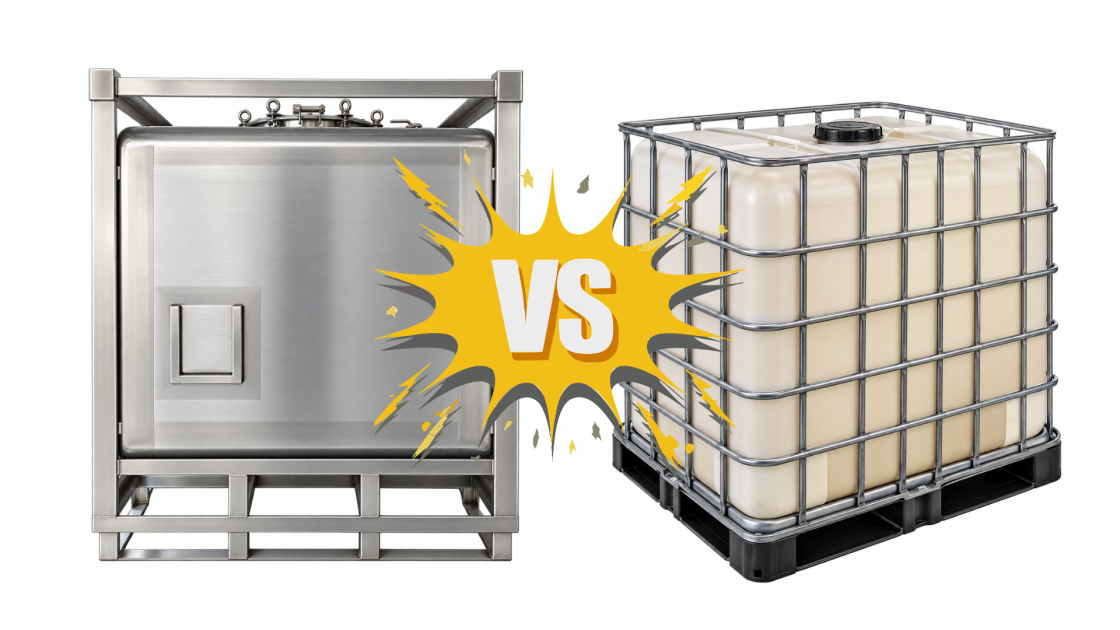
Plastic IBC Tote Tank
Many conventional plastic IBC tanks use an HDPE inner container supported by a metal cage and pallet base. Typical components include:
HDPE inner bottle
Metal protective cage
Pallet base
Top filling opening
Bottom discharge valve
Cap and fittings
Plastic IBC tanks are widely used for standardized storage and transportation applications. Their advantages often include lower initial cost, relatively low tare weight, and broad compatibility with many aqueous products.
However, compatibility must be confirmed for the specific chemical, concentration, temperature, and duration of contact.
HDPE inner bottle
Metal protective cage
Pallet base
Top filling opening
Bottom discharge valve
Cap and fittings
A stainless steel IBC tank uses a stainless steel vessel, which may be manufactured with welded construction and customized fittings.
Depending on the design, it may include:
Stainless steel body
Top manway
Special discharge connection
Customized valve
Insulation
Heating system
Agitator
Level indicator
Supporting frame
Forklift or lifting provisions
Stainless steel IBC tanks can be designed for more specialized applications, but their suitability depends on the material grade, construction, weld quality, surface finish, and operating conditions. Here is the direct comparison of stainless steel and plastic IBC tote tank:
Direct Comparison of SS and Plastic IBC Tote Tank
| Criteria | Stainless Steel IBC | Plastic IBC |
|---|---|---|
| Initial purchase cost | Higher | Lower |
| Empty weight | Heavier | Lighter |
| Mechanical durability | Generally robust, build to withstand impacts and heavy loads | More vulnerable to dents and physical damages |
| Chemical compatibility | Depends on stainless grade and product chemistry | Depends on polymer, additives, and product chemistry |
| Cleaning | Can support advanced cleaning systems such as CIP depending on design | Depends on internal design and cleaning procedure |
| Repeated use | Often suitable when properly maintained | Depends on type, condition, and intended reuse |
| Temperature capability | Depends on design and material grade | Generally more temperature-sensitive |
| UV exposure | Excellent durability and barrier performance, with resistance to UV-related polymer ageing. | UV resistance depends on material and protection |
| Customization | Generally high | Often more standardized |
| Service Life | Long with proper use and maintenance | Depends on usage, material compatibility, and maintenance |
| Process integration | Can accommodate special fittings and accessories | Usually less flexible for complex process integration |
| Transport | Requires consideration of higher tare weight | Lower tare weight may simplify handling |
| Certification | Application- and design-specific | Application- and design-specific |
Which one should I choose?
A stainless steel IBC tank may be worth considering when:
The product being stored is chemically aggressive, has a strong solvent base, or is otherwise incompatible with common polymers
The application requires elevated or fluctuating temperatures, heating, or insulation
The process demands hygienic design, advanced cleaning (such as CIP), or frequent sterilization
The tank needs special fittings, agitators, level indicators, or integration into an automated process line
Long-term durability and repeated reuse over many years are more important than initial purchase cost
Regulatory or internal quality standards require specific material certification
A plastic IBC tank may be a suitable option when:
The product is aqueous-based or otherwise compatible with HDPE and standard fittings
Initial investment cost and overall tare weight are important considerations
The tank will be used for straightforward storage, transport, or one-time/limited handling
Standardized capacities and designs already meet the operational requirement
UV exposure and long-term chemical resistance are not major concerns for the specific use case
Factors that should always be evaluated case by case:
Compatibility between the product and the tank material, including concentration, temperature, and duration of contact
Handling and transport conditions, including whether the tank will be moved frequently or remain stationary
Cleaning frequency and method, particularly for regulated industries such as food, pharmaceutical, or cosmetics
Applicable safety, certification, and compliance requirements for the specific product and region
Total cost of ownership, not only the initial purchase price, including maintenance, cleaning, and expected service life
Because these factors vary significantly between applications, the safest approach is to evaluate the specific product, process, and operating conditions before finalizing a decision. Consulting with a tank manufacturer or supplier who can assess these details can help ensure that the selected IBC tank, whether stainless steel or plastic, matches the actual requirements of the application rather than general assumptions
Still Not Sure Which IBC Tank Is Right for Your Application?
Talk to Our Team
WA: +62 878-8073-3615
E-mail: sales1@rhosigmatrijaya.co.id