What Is a Laboratory Mixer? Functions, Applications, and Benefits for R&D
Learn what a laboratory mixer is, how it works, its applications, key parameters, and how lab mixing supports formulation development and production scale-up.
Developing a new product often starts with a small batch. Before a formulation is transferred to a production-scale mixing system, engineers and R&D teams need to understand how the materials behave during mixing, dispersion, homogenization, and other processing steps. This is where a laboratory mixer becomes an important tool.
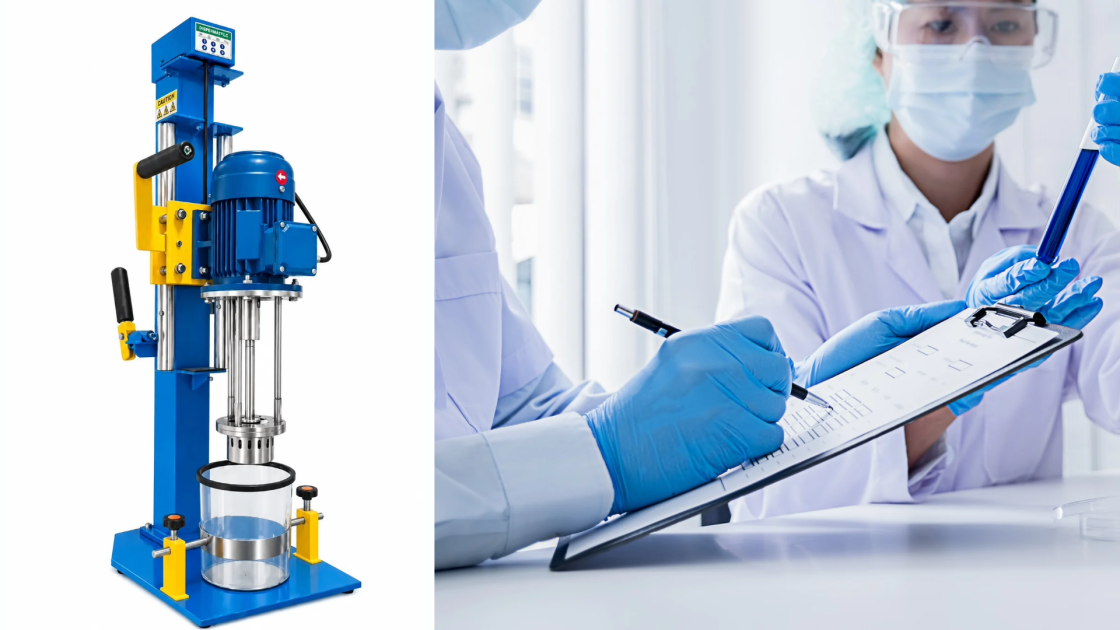
A laboratory mixer is a compact mixing machine designed for small-batch processing, formulation development, laboratory testing, and research and development (R&D). Depending on its configuration, a laboratory mixer can perform different types of processes, including general mixing, high-speed dispersion, high-shear mixing, and homogenization.
Unlike a production mixer, which is primarily designed to process large quantities of material, a laboratory mixer allows engineers and formulators to experiment with small quantities of raw materials while controlling important process parameters.
This makes it particularly useful when developing new formulations or evaluating changes to an existing product.
What Is a Laboratory Mixer?
A laboratory mixer is a small-scale industrial mixing machine used to combine, disperse, or homogenize materials under controlled conditions.
It is commonly used in:
Research and development
New product formulation
Raw material evaluation
Process development
Small-batch testing
Quality and comparative testing
Scale-up studies
Pilot process evaluation
A laboratory mixer typically consists of a motor and drive system, mixing shaft, interchangeable impeller or mixing tool, vessel or mixing container, and a control system for adjusting operating conditions.
Depending on the application, the mixer may be equipped with different types of impellers.
For example, one configuration may be optimized for general mixing, while another may be designed for high-speed dispersion or high-shear processing.
This flexibility allows one laboratory mixer platform to support multiple development activities.
What Is a Laboratory Mixer Used For?
The primary purpose of a laboratory mixer is to allow R&D teams to evaluate how a formulation behaves under controlled mixing conditions.
A small laboratory batch can provide important information before a product is manufactured on a much larger production machine.
Typical objectives include:
1. Developing a New Formulation
When developing a new product, engineers and formulators need to determine how different raw materials interact.
A laboratory mixer allows them to test variables such as:
Raw material ratios
Mixing sequence
Mixing speed
Mixing time
Temperature
Impeller configuration
Addition method
Dispersion conditions
Because only a small quantity of material is required, multiple formulation trials can be performed without consuming large amounts of raw material.
2. Testing Pigment Dispersion
In the paint, coating, and ink industries, laboratory mixers are frequently used to investigate pigment dispersion.
The objective may include evaluating:
Dispersion quality
Fineness
Color development
Mixing time
Viscosity behavior
Pigment loading
Wetting performance
A laboratory-scale disperser can help determine whether a formulation can achieve the required dispersion before moving to a larger production-scale High Speed Disperser.
3. Evaluating Mixing Performance
Laboratory mixing is also useful for determining whether a particular impeller or operating condition is suitable for a formulation.
Engineers can compare:
Different impeller designs
Different speeds
Different mixing times
Different batch sizes
Different raw material addition sequences
The results can then be used as part of the process development and scale-up study.
Laboratory Mixer vs. Production Mixer
A laboratory mixer and a production mixer perform similar basic functions, but they are designed for very different purposes.
| Laboratory Mixer | Production Mixer |
|---|---|
| Small batch size | Large batch size |
| Primarily for R&D and testing | Primarily for manufacturing |
| Compact design | Larger equipment footprint |
| Flexible configuration | Usually optimized for a specific process |
| Requires relatively small material quantities | Designed for high material throughput |
| Used for formulation development | Used for continuous or batch production |
| Useful for process evaluation | Designed for production efficiency |
The laboratory mixer is therefore not simply a "small production mixer."
Its primary value is process development and learning.
The information obtained from laboratory trials can help engineers make better decisions when designing or selecting production-scale equipment.
Can a Laboratory Mixer Be Used as a High Speed Disperser?
Yes, depending on the machine configuration.
A laboratory mixer can be designed with a high-speed disperser blade for applications that require stronger shear and dispersion.
This configuration is commonly used for products such as:
Paint
Coating
Printing ink
Pigment concentrates
Adhesives
Chemical formulations
The high-speed disperser configuration generates intensive movement around the impeller, helping to break down agglomerates and distribute solid particles throughout the liquid phase.
However, dispersion performance is not determined by RPM alone.
Important parameters include:
Tip speed
Blade diameter
Product viscosity
Solids concentration
Impeller design
Vessel geometry
Batch size
Mixing time
Material characteristics
Therefore, laboratory testing should focus not only on achieving a particular RPM, but also on understanding the relationship between machine parameters and product performance.
Laboratory Mixer for High-Shear Mixing
Another possible configuration is a high-shear mixing system.
High-shear mixing is used when a formulation requires more intensive mechanical action than conventional low-speed mixing.
Depending on the application, high-shear mixing may be used to improve:
Solid-liquid incorporation
Particle dispersion
Emulsion formation
Ingredient distribution
Homogenization
Deagglomeration
The appropriate mixing tool depends heavily on the formulation and desired process result.
For this reason, laboratory-scale testing is valuable before selecting a production-scale mixing technology.
Laboratory Mixer for Homogenization
Some laboratory mixer configurations can also be equipped for homogenization.
Homogenization aims to produce a more uniform distribution of components within a formulation.
It can be relevant to applications involving:
Liquid-liquid systems
Emulsions
Suspensions
Cosmetic formulations
Pharmaceutical formulations
Food products
Chemical formulations
The required homogenization technology depends on the properties of the materials and the required particle or droplet size.
A laboratory system allows these conditions to be evaluated using relatively small sample quantities.
Why Is a Laboratory Mixer Important for Product Development?
One of the biggest advantages of laboratory mixing is the ability to experiment before scaling up.
Imagine a company developing a new coating formulation.
Instead of immediately producing hundreds of kilograms, the R&D team can first test a small batch.
They can evaluate:
Raw material compatibility
Mixing sequence
Mixing speed
Dispersion behavior
Processing time
Product viscosity
Final appearance
Stability
Required mixing technology
If the formulation does not perform as expected, it can be modified and tested again.
This significantly reduces the material and production resources required during early-stage development.
Laboratory Mixing and Scale-Up
Laboratory mixing is particularly valuable because it can provide information for process scale-up.
However, scaling a process from laboratory equipment to production equipment is not simply a matter of multiplying the batch size.
The physical conditions inside the vessel change as the equipment becomes larger.
Engineers may need to consider parameters such as:
Impeller diameter
Tank diameter
Liquid height
Tip speed
Power input
Power per unit volume
Mixing time
Shear conditions
Flow pattern
Viscosity
Heat transfer
Material addition rate
For example, two mixers operating at the same RPM can produce different process conditions if their impeller diameters are different.
This is why laboratory mixing data should be interpreted together with mixing geometry and process parameters when developing a scale-up strategy.
Key Parameters to Consider When Choosing a Laboratory Mixer
Not every laboratory mixer is suitable for every application.
Before selecting a machine, it is useful to define the process requirements.
1. Batch Size
Determine the minimum and maximum quantity that needs to be processed.
A laboratory mixer should be capable of operating effectively across the intended working range.
2. Product Viscosity
Viscosity has a major influence on mixing behavior and motor requirements.
A mixer designed for low-viscosity liquids may not be suitable for highly viscous formulations.
3. Required Mixing Process
Determine whether the application requires:
General mixing
High-speed dispersion
High-shear mixing
Homogenization
Solid-liquid incorporation
Liquid-liquid mixing
The required process will influence the appropriate mixing tool.
4. Impeller Type
The impeller is one of the most important components of a laboratory mixer.
Different impeller geometries produce different flow patterns and shear characteristics.
Depending on the application, interchangeable mixing tools can make the laboratory mixer much more versatile.
5. Speed Range
The required speed range depends on the application.
A wide and controllable speed range allows engineers to investigate how different operating conditions affect the final product.
6. Material of Construction
The wetted parts should be selected according to the product and process requirements.
For industrial applications, stainless steel such as SUS304 or SUS316L may be considered depending on chemical compatibility, hygiene requirements, corrosion resistance, and application conditions.
7. Process Control
For R&D work, repeatability is important.
The ability to control and record parameters such as:
RPM
Mixing time
Temperature
Batch size
Impeller configuration
can make laboratory experiments easier to compare.
Which Industries Use Laboratory Mixers?
Laboratory mixers are used across a wide range of industries.
Paint and Coating
Used for formulation development, pigment dispersion, resin blending, and testing of new coating systems.
Printing Ink
Used for pigment incorporation, dispersion development, and evaluation of ink formulations.
Adhesive and Sealant
Used to evaluate raw material compatibility, mixing sequence, viscosity, and formulation performance.
Chemical Industry
Used for product development, chemical formulation, and small-scale process evaluation.
Cosmetics
Laboratory mixers can be used for developing creams, lotions, gels, and other cosmetic formulations, depending on the required mixing technology.
Food Industry
Used for small-scale formulation development and ingredient blending.
Pharmaceutical R&D
Laboratory mixing systems may be used for formulation development and controlled small-scale processing, subject to the required hygienic and regulatory design.
What Makes a Good Laboratory Mixer?
A useful laboratory mixer should provide more than simply rotational movement.
For R&D applications, several characteristics are particularly valuable:
Flexibility
The machine should support different mixing configurations where the process requires them.
Controllability
Speed and other process parameters should be adjustable with sufficient precision for experimental work.
Repeatability
The same process conditions should be capable of being reproduced across different trials.
Compact Design
Laboratory space is often limited, so a compact machine is advantageous.
Durable Construction
The machine should be designed to withstand repeated testing and industrial R&D environments.
Customization
Different products may require different mixing tools, vessel sizes, materials of construction, or control configurations.
RST Laboratory Mixer: Flexible Mixing for R&D and Small-Scale Testing
The RST Laboratory Mixer is designed as a compact and flexible platform for research and development, formulation development, laboratory testing, and pilot-scale process evaluation.
Depending on the selected configuration, the system can be adapted for different mixing applications, including:
General laboratory mixing
High Speed Dispersion
High-shear mixing
Homogenization
This flexibility allows one laboratory-scale platform to support different stages of product development.
The RST Laboratory Mixer can be configured for applications in:
Paint and coating
Printing ink
Adhesive and sealant
Chemical products
Cosmetics
Food
Pharmaceutical R&D
The machine is designed with an emphasis on process control, operational flexibility, compact installation, durability, and application-specific customization.
For R&D teams, this provides a practical way to evaluate formulations using small quantities before moving toward larger-scale processing.
From Laboratory Trial to Production Scale
A laboratory mixer is more than a small piece of equipment.
It can become an important part of a company's product development and process engineering workflow.
A typical development path may look like:
Raw Material Selection
↓
Laboratory Formulation
↓
Mixing / Dispersion Testing
↓
Performance Evaluation
↓
Process Optimization
↓
Scale-Up Study
↓
Pilot Testing
↓
Production Equipment
The better the laboratory data, the more information engineers have when making decisions about the next stage of the process.
Conclusion
A laboratory mixer is a compact and flexible machine used for R&D, formulation development, small-batch mixing, dispersion, homogenization, and process evaluation.
Its main value is not simply its smaller size compared with a production mixer.
The real value is its ability to help engineers and formulators test ideas, compare formulations, optimize process parameters, and generate useful data before committing to larger-scale production.
Depending on its configuration, a laboratory mixer can function as a general mixer, High Speed Disperser, high-shear mixer, or homogenizing system.
For companies developing products in paint, coating, ink, adhesive, chemical, cosmetic, food, or pharmaceutical applications, laboratory-scale mixing can provide an important bridge between formulation development and industrial production.
The right laboratory mixer can help turn a formulation concept into a repeatable and scalable manufacturing process.
Looking for a Laboratory Mixer for Your R&D Process?
RST can develop a laboratory mixing solution according to your product characteristics, batch size, viscosity, mixing objective, impeller requirements, and process conditions.
Whether you need a system for formulation development, pigment dispersion, high-shear mixing, homogenization, or small-scale process evaluation, the equipment can be configured around your specific application.