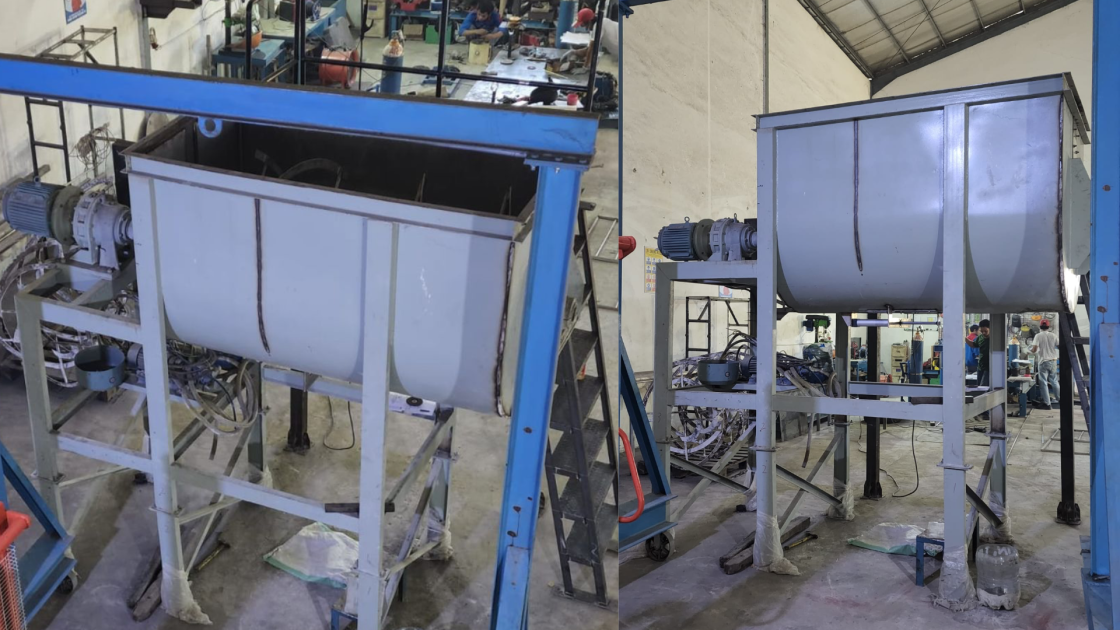
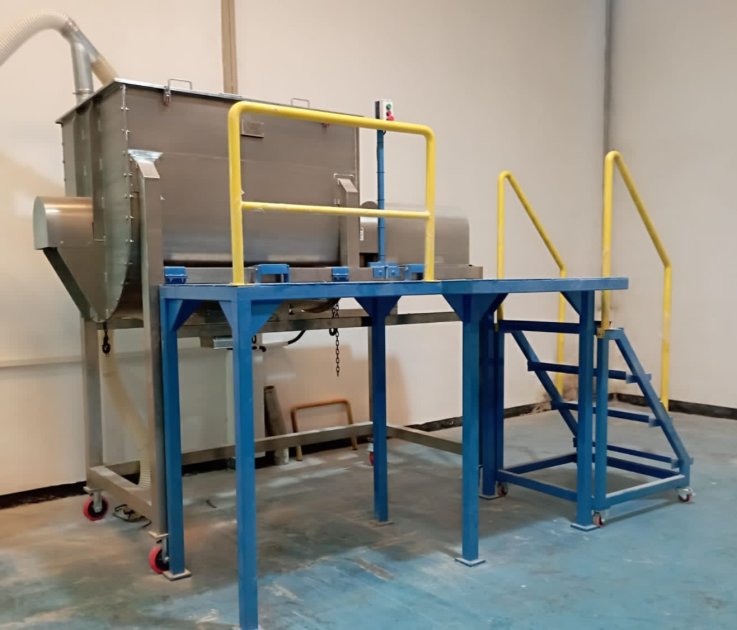
Ribbon Mixer 400 kg untuk Industri Adhesive Powder
ribbon mixer industri, mesin pengaduk powder, ribbon blender 400 kg, mesin mixing adhesive, mesin filling powder 25 kg, ribbon mixer dengan sistem packaging
400 kg Ribbon Mixer for Adhesive Powder Production: Integrating Mixing and Packaging
An Adhesive Manufacturer Approaches RST with a Production Challenge
When an adhesive manufacturing company approached PT Rho Sigma Trijaya (RST), its requirement went beyond simply mixing raw materials. The company wanted to improve production efficiency, from mixing powder raw materials to packaging the finished product.
In adhesive powder production, mixing is a critical stage. Different raw materials must be blended according to the required formulation before moving to the next production process.
The customer wanted a more practical workflow. In addition to a mixer with the appropriate capacity, the company needed a system that could connect to the packaging equipment, reducing the need to rely entirely on manual material transfer after mixing.
Based on these requirements, RST identified that the solution needed to be more than just a mixer. It required a series of equipment designed to support the production flow from mixing to packaging.
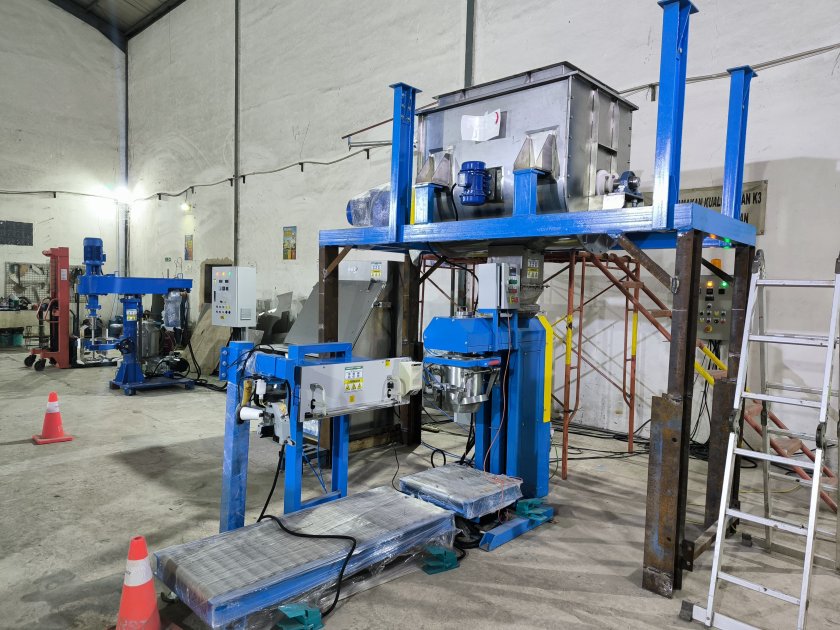
RST developed a system consisting of a 400 kg SUS304 ribbon mixer, a semi-automatic filling system for 25 kg bags, a dust collector, a conveyor, a plastic bag sealer, and a bag sewing machine.
With this configuration, the mixing and packaging processes can be arranged as a more integrated production workflow.
Why Choose a Ribbon Mixer for Adhesive Powder?
A ribbon mixer is a type of industrial mixer commonly used for blending powder and granular materials.
The machine uses ribbon-shaped blades mounted on a horizontal shaft inside the mixing chamber. As the shaft rotates, the material moves along the chamber, promoting material movement and helping achieve a uniform mixture.
For adhesive powder applications, ribbon mixer selection should consider raw material characteristics, particle size, bulk density, formulation, batch capacity, and the required level of mixing uniformity.
Therefore, selecting a mixer based on kilogram capacity alone is not sufficient. Chamber volume, blade configuration, drive system, and discharge mechanism must also be considered to ensure the equipment suits the production requirements.
For this project, RST specified a ribbon mixer with a mixing capacity of 400 kg, using SUS304 stainless steel for the components designated in the specification.
Ribbon Mixer Specifications for This Project
| Parameter | Specification |
|---|---|
| Equipment | Industrial Ribbon Mixer |
| Mixing Capacity | 400 kg |
| Product Application | Powder adhesive raw materials |
| Product-Contact Material | SUS304 stainless steel |
| Main Dimensions | Approximately 2,800 × 1,114 × 1,413 mm |
| Mixing Chamber Dimensions | 1,200 × 800 × 950 mm |
| Motor Power | 7.5 kW / 10 HP |
| Mixing Speed | 57 RPM |
| Discharge System | Customized pneumatic outlet |
| Surface Finishing | Internal and external polishing, Grit #220 |
SUS304 stainless steel was selected as part of the equipment configuration for industrial material processing. Compatibility with the adhesive formulation should still be verified based on its chemical composition and the customer's process requirements.
The drive system uses a gearmotor rated at 7.5 kW or 10 HP, with a mixing speed of 57 RPM. An inverter is used to adjust motor speed according to the machine's operating configuration.
Operating parameters should be adjusted based on material characteristics and mixing test results.
Beyond Mixing: Integrating the Filling and Packaging System
One of the customer's main requirements was to connect the mixing process with the packaging process.
In a production system without integrated equipment, the mixed powder may need to be transferred to a separate filling area. This can add material-handling steps and require more operator involvement.
To address this requirement, RST designed a supporting equipment line that includes a discharge system, docking station, dust collector, semi-automatic filling system, gravity roller conveyor, plastic bag sealer, and bag sewing machine.
Each component serves a different function while supporting the overall material flow from mixing to packaging.
1. Customized Discharge System and Docking Station
After mixing is complete, the material must be discharged from the chamber and directed to the next process.
For this project, the ribbon mixer is equipped with a SUS304 discharge outlet operated by a pneumatic cylinder. The specified outlet dimensions are approximately 200 × 300 mm.
RST also provides a docking station with a pneumatic door system and safety interlock connected to the dust collector.
This configuration is designed to support controlled material transfer while providing a connection point for the dust collection system.
The integration of the discharge system and docking station is important because the outlet design must match the equipment receiving the powder after mixing.
2. Dust Collector for Powder Handling
Powder materials may generate dust when discharged from the mixer or transferred to the filling machine. Dust control should therefore be considered as part of the equipment design.
For this project, RST provides a dust collector with the following specifications:
Motor power: 1 HP
Voltage: 220 V
Rotational speed: 2,850 RPM
Bag capacity: 57 liters
Flexible ducting: 4 inches × 6 meters
The dust collector is connected to the docking station according to the project configuration, including the interlock arrangement for the pneumatic door system.
The purpose is to help control dust in the powder-handling area. Actual effectiveness depends on material characteristics, suction point positioning, installation conditions, and system operation.
For materials that may generate combustible dust, additional safety assessments are required based on the characteristics of the material.
3. Semi-Automatic Filling System for 25 kg Bags
After mixing, the material is directed to a filling system designed to fill bags with a target weight of 25 kg.
The system uses a dosing screw conveyor to feed powder into the packaging. The filling equipment includes a SUS304 hopper, a 0.37 kW motor, an inverter, a pneumatic clamping system, and a weighing system.
The weighing components include a load cell with a stated capacity of 100 kg, connected to a weighing indicator.
The system is designed to allow the operator to set the target filling weight through the weighing indicator. Once the bag is positioned and clamped at the outlet, the dosing screw feeds powder into the bag until the configured target weight is reached.
The general operating sequence is as follows:
The operator enters the target weight on the weighing indicator.
The bag is positioned at the filling outlet and secured using the pneumatic clamping system.
The dosing screw conveyor feeds powder into the bag.
The dosing process stops when the configured target weight is reached.
After filling is complete, the operator releases the clamp and transfers the bag to the next process.
This is a semi-automatic system. The operator remains involved in bag positioning and post-filling handling, while the dosing process is supported by the weighing system.
Actual filling accuracy and weight consistency depend on scale calibration, powder flow characteristics, dosing settings, and operating conditions.
4. Conveyor, Plastic Bag Sealer, and Bag Sewing Machine
Packaging involves more than filling the material. Once a bag is filled, it must also be transferred and closed according to the packaging requirements.
To support these stages, RST provides several additional pieces of equipment.
Gravity Roller Conveyor
The conveyor uses galvanized rollers, with an approximate working width of 500 mm and a length of 1,500 mm. It supports bag movement between work areas.
Plastic Bag Sealer
The machine is used to seal plastic packaging according to the type of packaging material.
Bag Sewing Machine
The sewing machine is used to close bags that require stitching after filling.
Together, these pieces of equipment complete the process from powder mixing to bag closure.
Ribbon Mixer with an Integrated Packaging System
This project demonstrates the application of a ribbon mixer integrated with filling and packaging equipment to support adhesive powder production.
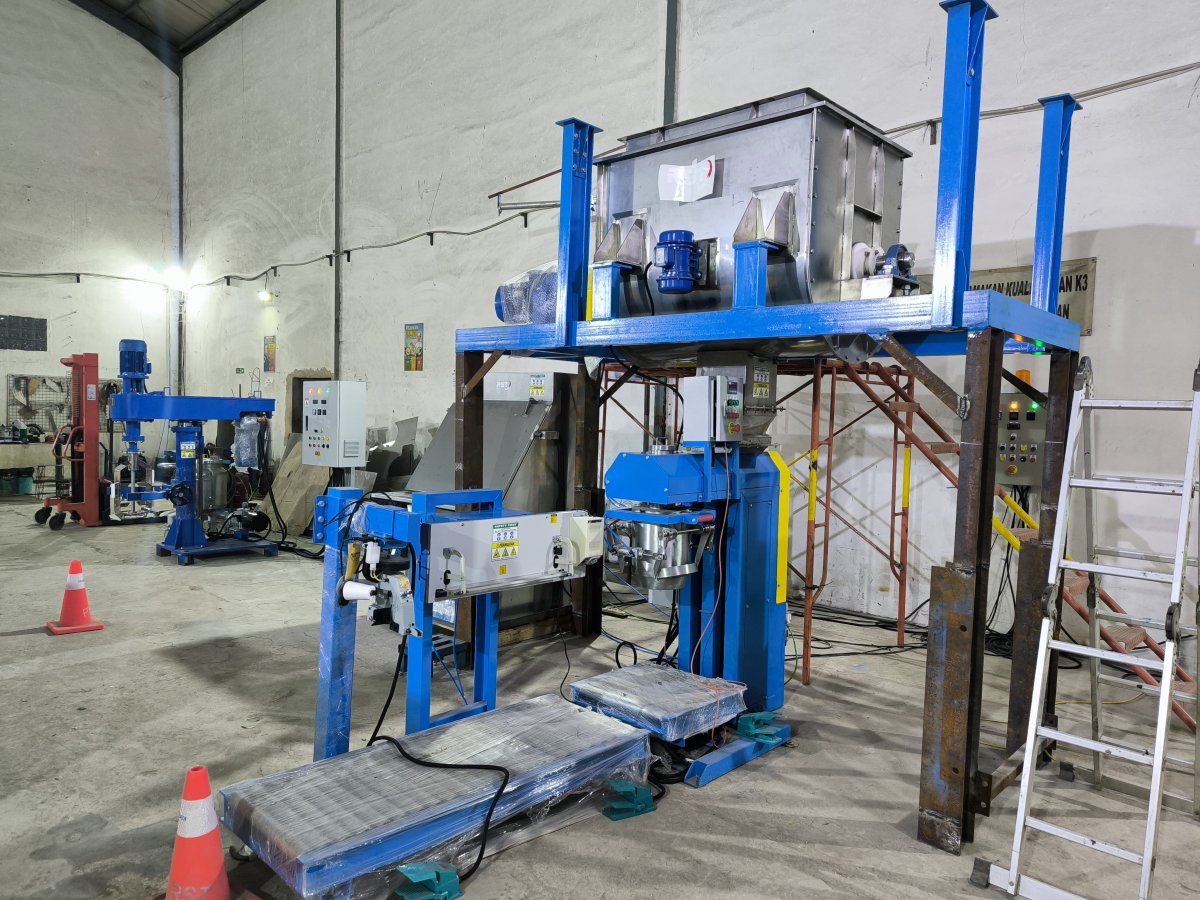
With this equipment arrangement, material can move from mixing to bag filling and then proceed to the bag-closing process.
How Does the Ribbon Mixer Production Workflow Operate?
An important consideration in this project is how material moves from one process stage to the next.
The overall workflow can be summarized as follows:
Raw Material Preparation → Ribbon Mixer Mixing → Powder Discharge → Dosing Screw Filling → Weighing → Bag Sealing or Sewing
The ribbon mixer blends the raw materials, while the discharge system and supporting equipment direct the material to the filling stage.
The dosing screw then feeds the powder into bags according to the target weight. Filled bags proceed to plastic sealing or bag sewing, depending on the packaging requirements.
This integration is designed to reduce the separation between mixing and packaging processes. However, the system remains semi-automatic and is not a fully automated packaging line.
Actual production output is not determined by the 400 kg mixer capacity alone. Mixing time per batch, discharge rate, filling speed, bag handling, and sealing or sewing time also affect overall production capacity.
Evaluating the cycle time of each stage is therefore necessary to estimate the output achievable under actual operating conditions.
An Engineering Solution Tailored to Customer Requirements
This project demonstrates that industrial equipment requirements often extend beyond a single machine's primary function.
The customer needed to mix adhesive powder raw materials while also making the subsequent production stages more practical. The challenge was to ensure that the mixing machine, discharge system, dust collection equipment, and packaging equipment could operate as an integrated arrangement suited to the customer's production workflow.
RST addressed this requirement by providing a 400 kg SUS304 ribbon mixer equipped with a customized discharge system and supporting filling and packaging equipment. The project scope also included installation services for the ribbon mixer and filling system.
This approach places the customer's process requirements at the center of the equipment design, rather than selecting a mixer based solely on capacity and leaving downstream equipment integration to the customer.
For manufacturers producing adhesive powder or other powdered materials, considering the process from mixing through packaging at the initial design stage can help create an equipment configuration that better suits the factory workflow.
Looking for a Ribbon Mixer for Powder Production?
Selecting a ribbon mixer involves more than batch capacity. Raw material characteristics, required mixing uniformity, construction material, discharge mechanism, dust control, and packaging methods are all important factors in evaluating the system.
PT Rho Sigma Trijaya (RST) provides industrial mixing machinery and stainless steel process equipment tailored to application requirements. Its equipment range includes ribbon mixers, high speed dispersers, paste mixers, mixing tanks, and various industrial mixing systems.
For production processes involving adhesive powder, chemical powder, or other dry materials, mixing and packaging requirements can be evaluated as part of an integrated process.
By understanding material characteristics and production flow from the beginning, equipment selection can be based on actual process requirements.
FAQ: Ribbon Mixer for Powder Applications
What is the function of a ribbon mixer in adhesive powder production?
A ribbon mixer is used to blend powder or granular materials. Ribbon blades inside a horizontal chamber move the material during mixing. Machine suitability depends on material characteristics, formulation, batch capacity, and the required level of mixing uniformity.
What is the ribbon mixer capacity for this RST project?
The ribbon mixer has a stated mixing capacity of 400 kg. The actual batch weight should be determined based on material bulk density, working chamber volume, and material characteristics.
Can a ribbon mixer be integrated with a powder filling machine?
Yes. A ribbon mixer can be designed with a suitable discharge system and filling equipment. Integration design should consider material flow, outlet positioning, dust collection requirements, and filling machine configuration.
Is this ribbon mixer system fully automated from mixing to packaging?
The system combines mixing and packaging equipment in one workflow, but the packaging process is semi-automatic. Operators remain involved in bag positioning and handling after filling.
Why is a dust collector needed in powder mixing processes?
A dust collector helps control dust that may be generated during discharge and filling. Its capacity and configuration should be selected based on powder characteristics and dust control requirements in the working area.
What is the construction material of the ribbon mixer in this project?
The project specification uses SUS304 stainless steel for designated product-contact components, with internal and external polishing to Grit #220. Material compatibility should still be verified against the chemical characteristics of the adhesive being processed.
Does RST provide custom mixing machines?
RST provides industrial mixing machines and process equipment that can be designed around application requirements. Configurations may consider capacity, material characteristics, machine construction, discharge systems