Types of Tank Agitators: Functions, Types, and How to Choose
Discover the main types of tank agitators, their functions, applications, and selection criteria. Learn how viscosity, tank capacity, and mixing requirements affect agitator design
Introduction
Mixing is one of the most important processes in industrial manufacturing. It directly affects product quality, consistency, and overall production efficiency.
Industries such as paint and coatings, printing inks, chemicals, adhesives, food processing, and pharmaceuticals require properly designed mixing systems to achieve the desired product characteristics.
One of the key components of an industrial mixing system is the tank agitator.
A tank agitator is a mechanical device designed to generate material movement inside a vessel through a rotating shaft and mixing element. It supports material blending, particle suspension, solid-liquid dispersion, and product uniformity.
However, different materials require different mixing mechanisms. Factors such as viscosity, density, solid content, particle size, and shear requirements all influence agitator selection.
This guide explains the main types of tank agitators, their functions, industrial applications, and the engineering factors involved in selecting the right agitator for your manufacturing process.
1. What Is a Tank Agitator?
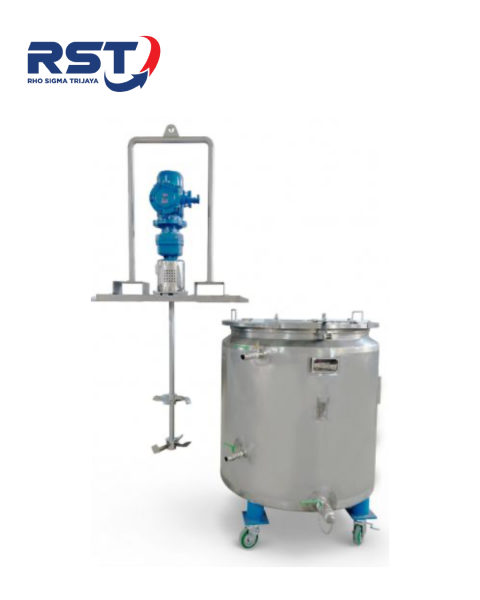
A tank agitator is a mechanical mixing device installed in a vessel to generate controlled material movement during an industrial process.
A typical tank agitator system consists of the following components:
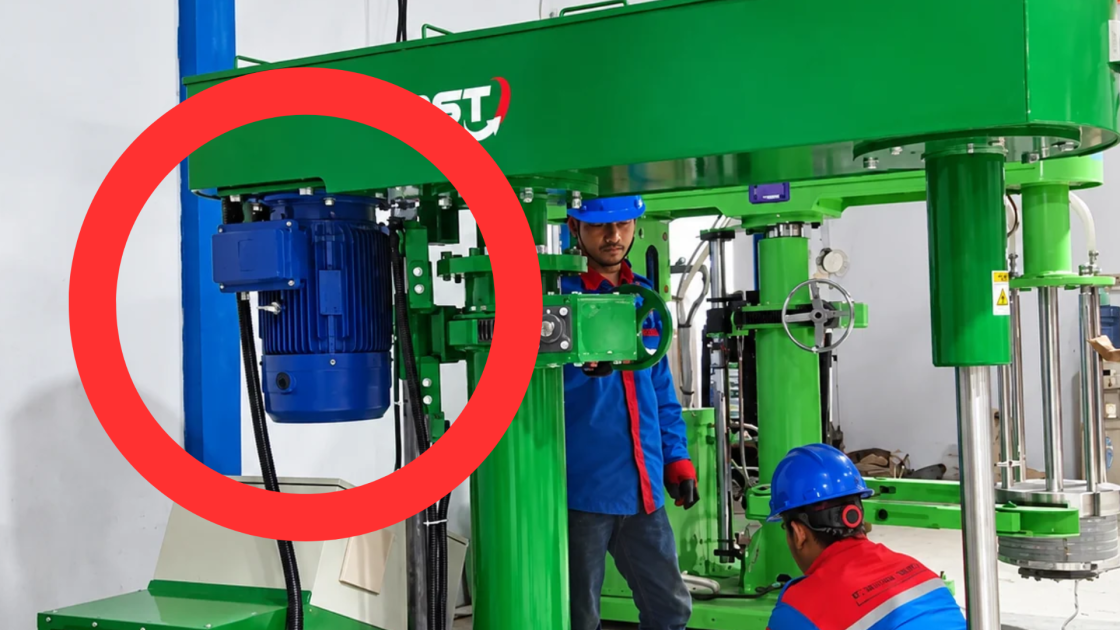
Electric Motor: Supplies the mechanical power required to drive the mixing system.
Gearbox: Reduces rotational speed and increases torque according to process requirements.
Agitator Shaft: Transfers rotational power from the drive system to the mixing element.
Impeller or Mixing Blade: Generates fluid movement and shear forces.
Mixing Vessel: Contains the material during the mixing process.
Depending on the vessel design and process requirements, industrial agitators can be installed in top-entry, side-entry, or bottom-entry configurations.
The appropriate configuration depends on tank geometry, material characteristics, and operating conditions.
2. Main Functions of Industrial Tank Agitators
Industrial agitators perform several important functions beyond simply stirring materials.
A. Material Blending
Blending is the process of combining two or more materials to achieve a uniform mixture.
Typical applications include:
Paint formulation.
Chemical liquid blending.
Food ingredient preparation.
Adhesive manufacturing.
B. Solid Particle Suspension
Agitators help maintain solid particles in suspension within a liquid, reducing the risk of sedimentation at the bottom of the tank.
Typical applications include:
Pigment mixing.
Mineral slurry processing.
Chemical suspensions.
High-solid-content formulations.
C. Solid-Liquid Dispersion
Dispersion involves distributing solid particles throughout a liquid phase while helping break down particle agglomerates.
This process is commonly used in paint, printing ink, coatings, and chemical manufacturing.
For applications requiring high shear, a High Speed Disperser is commonly used.
D. Heat Transfer Improvement
Agitation improves material circulation inside the vessel, supporting more uniform temperature distribution.
This is particularly important in mixing tanks equipped with heating or cooling jackets.
E. Product Uniformity
Agitators can maintain product uniformity during processing and temporary holding operations, especially when material separation or sedimentation needs to be controlled.
3. Types of Tank Agitators
Different agitator designs produce different flow patterns and mixing characteristics. Selecting the correct type is essential for achieving the required process performance.
A. Propeller Agitator
A propeller agitator uses blades similar to a marine propeller to generate axial flow along the vessel.
Characteristics:
Produces upward or downward circulation.
Suitable for low-viscosity liquids.
Provides effective liquid circulation.
Typically operates at relatively high rotational speeds.
Applications:
Water treatment.
Chemical blending.
Industrial liquid mixing.
Tank circulation systems.
B. Turbine Agitator
A turbine agitator consists of multiple blades mounted around a central hub.
Depending on the blade configuration, it can generate radial or axial flow.
Characteristics:
Available in flat-blade and pitched-blade configurations.
Can produce turbulence and shear.
Suitable for different industrial mixing requirements.
Can be designed for liquid blending, suspension, and gas-liquid mixing.
Applications:
Chemical processing.
Paint and coatings manufacturing.
Liquid blending.
Gas dispersion.
C. Paddle Agitator
A paddle agitator uses flat mixing blades to move materials inside the vessel.
Characteristics:
Relatively simple mechanical construction.
Generally operates at low to moderate speeds.
Suitable for general-purpose mixing.
Can be used for low- to medium-viscosity materials, depending on design.
Applications:
Liquid blending.
Chemical mixing.
Water-based products.
Selected food processing applications.
D. Anchor Agitator
An anchor agitator features a mixing blade shaped to follow the internal contour of the tank wall.
It is commonly used for high-viscosity materials.
Characteristics:
Operates at relatively low rotational speeds.
Provides suitable torque for viscous material movement.
Promotes circulation near the vessel wall.
Can be equipped with scrapers to reduce material buildup on the tank surface.
Applications:
Adhesives.
Resins.
Thick coatings.
Paste products.
High-viscosity chemical materials.
Anchor agitators are also commonly installed in jacketed vessels to support material circulation and more uniform temperature distribution.
E. Helical Ribbon Agitator
A helical ribbon agitator uses spiral-shaped blades arranged around a central shaft.
Its design promotes material circulation throughout the vessel, particularly for highly viscous products.
Characteristics:
Designed to generate axial material circulation.
Suitable for viscous liquids and paste-like materials.
Promotes upward and downward material movement.
Can be engineered according to vessel geometry.
Applications:
Adhesives.
Polymers.
Chemical pastes.
High-viscosity compounds.
Specialty industrial materials.
Helical ribbon agitators are widely used in ribbon mixing equipment and other specialized mixing systems.
F. High Speed Disperser
A High Speed Disperser is a specialized mixing system equipped with a toothed disc designed to generate high shear forces around the impeller.
It helps wet out solid materials, distribute particles, and break down agglomerates during the dispersion process.
Characteristics:
Operates at high rotational speeds.
Generates high local shear around the disperser disc.
Suitable for solid-liquid dispersion.
Can be combined with an anchor agitator.
Applications:
Paint and coatings.
Printing inks.
Pigment dispersion.
Chemical manufacturing.
Adhesive production.
For high-viscosity formulations, combining a High Speed Disperser with an anchor agitator can improve dispersion and overall material circulation.
4. Comparison of Different Tank Agitators
| Agitator Type | Flow Characteristics | Typical Applications |
|---|---|---|
| Propeller | Axial flow | Liquid blending |
| Turbine | Radial or axial flow | Chemical mixing |
| Paddle | Depends on blade design | General mixing |
| Anchor | Circulation near vessel wall | High-viscosity materials |
| Helical Ribbon | Axial circulation | Pastes and viscous materials |
| High Speed Disperser | High local shear | Paint and pigment dispersion |
Actual performance depends on impeller geometry, diameter, rotational speed, vessel dimensions, and material properties.
5. How to Choose the Right Tank Agitator
Choosing the right agitator requires a proper engineering evaluation. Tank capacity alone is not sufficient to determine the appropriate mixing system.
The following factors should be considered.
A. Material Viscosity
Viscosity is one of the most important parameters in agitator selection.
General guidelines include:
Low viscosity: Propeller or turbine agitators.
Medium viscosity: Turbine or paddle agitators.
High viscosity: Anchor or helical ribbon agitators.
Final selection must also consider how viscosity changes during processing, including shear-thinning and thixotropic behavior.
B. Tank Capacity and Geometry
Tank dimensions directly influence the flow pattern and mixing performance.
Important design parameters include:
Tank diameter.
Tank height.
Working volume.
Vessel bottom configuration.
Impeller diameter.
Impeller position.
Baffle arrangement.
The impeller-to-tank diameter ratio should be evaluated based on the selected agitator design and process requirements.
C. Material Properties
Other material characteristics must also be evaluated:
Specific gravity.
Density.
Solid content.
Particle size.
Operating temperature.
Abrasiveness.
Shear sensitivity.
Materials with high solid content or high density may require different impeller configurations and torque requirements.
D. Mixing Objectives
The required mixing objective must be clearly identified.
Common objectives include:
Blending multiple materials.
Maintaining solid particles in suspension.
Dispersing solid particles.
Supporting uniform heat transfer.
Maintaining product homogeneity.
One agitator design may not be suitable for every mixing objective.
E. Motor Power and Torque
Motor power and torque must be determined according to actual process requirements.
Factors affecting power consumption include:
Material viscosity.
Impeller diameter.
Rotational speed.
Impeller geometry.
Material density.
Operating and starting conditions.
For high-viscosity materials, sufficient torque at relatively low rotational speeds is particularly important.
F. Operating Speed
Agitator speed is generally expressed in RPM, or revolutions per minute.
The appropriate operating speed depends on:
Impeller type.
Impeller diameter.
Material viscosity.
Required shear.
Mixing performance objectives.
Mechanical operating limits.
Higher rotational speed does not automatically result in better mixing performance.
6. When Is a Dual Agitator System Required?
In certain industrial applications, a single agitator may not be sufficient to achieve all required mixing functions.
This is particularly common in high-viscosity formulations containing pigments, fillers, or other solid additives.
A dual agitator configuration can provide a more effective solution.
High Speed Disperser and Anchor Agitator
The High Speed Disperser performs the following functions:
Supports particle dispersion.
Generates high shear.
Improves material wetting.
Helps break down particle agglomerates.
The anchor agitator performs the following functions:
Moves high-viscosity materials.
Supports overall vessel circulation.
Reduces stagnant regions.
Helps improve temperature uniformity in jacketed tanks.
This configuration is commonly used in paint, coatings, adhesives, and chemical manufacturing.
The engineering design must consider flow interaction, impeller positioning, power requirements, and mechanical clearances to ensure effective operation.
7. Common Mistakes in Tank Agitator Selection
Several common mistakes can reduce mixing efficiency and affect product quality.
Selecting an agitator based only on tank capacity.
Ignoring material viscosity and changes during processing.
Using a motor with insufficient torque.
Overlooking tank geometry and impeller positioning.
Assuming higher RPM always produces better mixing.
Ignoring solid particle characteristics and sedimentation risks.
Neglecting cleaning and maintenance requirements.
Proper agitator selection requires a complete understanding of the material and its processing conditions.
8. Benefits of Proper Agitator Design
A properly engineered agitator system can improve product quality, production efficiency, and equipment reliability.
Key benefits include:
More consistent mixing performance.
Reduced processing time.
Improved material distribution.
Better energy utilization.
Reduced sedimentation risks.
Improved temperature control.
More reliable manufacturing operations.
Because every material has different processing characteristics, agitator systems should be designed according to the actual application rather than using one standard configuration for all processes.
9. Industrial Agitator and Mixing Tank Solutions by RST
PT Rho Sigma Trijaya is an engineering and manufacturing company specializing in industrial mixing equipment and stainless steel tanks.
RST develops and manufactures industrial mixing solutions for various manufacturing applications, including:
High Speed Disperser Mixers.
Anchor Agitators.
Ribbon Mixers.
Paste Mixers.
Industrial Mixing Tanks.
Double Jacket Tanks.
Custom Mixing Systems.
Each system can be engineered according to material characteristics, production capacity, process requirements, and customer specifications.
If your company requires a suitable tank agitator or a customized industrial mixing system, the RST engineering team can help evaluate your process requirements and develop an appropriate solution.
Contact PT Rho Sigma Trijaya
Website: https://www.rhosigmatrijaya.co.id
Email: sales1@rhosigmatrijaya.co.id
Engineering the Right Mixing Solution for Your Process.
Frequently Asked Questions
1. What is the function of an agitator in a tank?
A tank agitator generates material movement to support blending, solid suspension, dispersion, product uniformity, and heat transfer.
2. What are the main types of tank agitators?
The main types include propeller, turbine, paddle, anchor, helical ribbon, and high speed disperser agitators.
3. Which agitator is suitable for high-viscosity materials?
Anchor and helical ribbon agitators are commonly used for high-viscosity materials. The final selection depends on material properties, tank geometry, and process requirements.
4. What is the difference between an agitator and a disperser?
An agitator primarily generates material circulation and mixing throughout the tank. A disperser generates higher shear forces to help distribute particles and break down agglomerates.
5. How is agitator motor power determined?
Motor power depends on impeller design, diameter, rotational speed, material viscosity, density, and operating conditions. Engineering calculations are required to determine the appropriate motor power and torque.
6. Can two agitators be installed in one tank?
Yes. A dual agitator system can be installed when a single mixing element cannot meet all process requirements. A common example is combining a High Speed Disperser with an anchor agitator for high-viscosity applications.
7. Does higher RPM always improve mixing performance?
No. Higher RPM may increase shear and turbulence, but it does not necessarily improve overall material circulation. Operating speed must be matched to the impeller design and material characteristics.