Paint vs Coating: What's the Difference?
Learn the difference between paint and coating, their main components, pigment dispersion, and why mixer selection matters in industrial paint and coating manufacturing.
Paint and coating are often used interchangeably, but in industrial applications they are not exactly the same. Paint is a type of coating, while coating is the broader term covering many protective, decorative, and functional surface treatments.
For manufacturers, understanding this distinction matters because different paint and coating formulations can require different mixing, dispersion, and processing conditions.
What Is Paint?
Paint is generally a pigmented coating material designed to provide color, opacity, appearance, and surface protection. A typical formulation contains four groups of ingredients:
- Binder or Resin — forms the film after drying/curing; affects adhesion, hardness, flexibility, chemical resistance, and durability.
- Pigments — provide color and opacity; some also add functional properties like corrosion protection and UV resistance.
- Solvent, Water, or Carrier — controls viscosity and processability.
- Additives — improve wetting, dispersion, flow, leveling, foam control, rheology, drying, and storage stability.
What Is a Coating?
Coating is a broader term for a material applied to a surface to form a protective, decorative, or functional layer. It can be pigmented or clear, and water-based, solvent-based, powder-based, or formulated for specific industrial applications.
Examples of industrial coatings:
- Epoxy coatings
- Polyurethane coatings
- Acrylic coatings
- Alkyd coatings
- Powder coatings
- Anti-corrosion coatings
- Marine coatings
- Automotive coatings
- Protective coatings
- Specialty functional coatings
Not every coating qualifies as paint — a clear protective coating may contain little or no pigment, while powder coating is applied as a dry powder rather than a liquid.
Main Components of Paint and Coatings
1. Binder or Resin
The film-forming component. Common systems: Acrylic, Alkyd, Epoxy, Polyurethane, Polyester. Influences adhesion, hardness, flexibility, chemical resistance, gloss, and durability.
2. Pigments
Provide color and opacity. Common types: Titanium dioxide (TiO₂), iron oxides, carbon black, organic pigments. Being insoluble particles, they must be properly wetted and dispersed.
3. Solvent or Water
Keeps the formulation workable and controls viscosity — can be water, organic solvent, a solvent blend, or other liquid carriers.
4. Additives
Used in small amounts but with significant impact: wetting agents, dispersants, defoamers, rheology modifiers, leveling agents, drying additives, anti-settling additives, UV stabilizers.
Paint vs Coating: Comparison Table
| Factor | Paint | Coating |
|---|---|---|
| Definition | A pigmented type of coating | Broader category of surface treatment |
| Pigment | Usually contains pigment | May be pigmented or clear |
| Main Purpose | Color, appearance, protection | Protection, decoration, or specific function |
| Typical Resin | Acrylic, alkyd, epoxy, polyurethane | Broader range of resin systems |
| Application | Brush, roller, spray, industrial | Spray, dip, roll, powder, other methods |
| Manufacturing Focus | Mixing, pigment dispersion, viscosity, color, stability | Depends on formulation and required performance |
Why the Difference Matters to Manufacturers
The key question isn't "is this paint or coating?" It's:
"What performance does the formulation need to achieve, and what manufacturing process can consistently deliver that performance?"
Two products both labeled "coating" can require completely different processing — one may need intensive pigment dispersion, another gentle blending. Equipment selection should follow process requirements, not just batch volume or motor power.
Why Is Pigment Dispersion Important?
Simply adding pigment to a tank and stirring isn't enough — pigment particles form agglomerates. The process must supply enough energy to wet, break down, disperse, and stabilize these particles:
WETTING → BREAKING AGGLOMERATES → DISPERSION → STABILIZATION
Good dispersion delivers: consistent color, hiding power, gloss, viscosity, storage stability, and surface appearance.
Poor dispersion causes: inconsistent color, poor hiding power, lower gloss, viscosity variation, sedimentation, color separation, and surface defects.
What Mixer Is Used for Pigment Dispersion?
A high speed disperser (HSD) is one of the commonly used industrial mixers for pigment dispersion in paint, ink, and coating manufacturing.
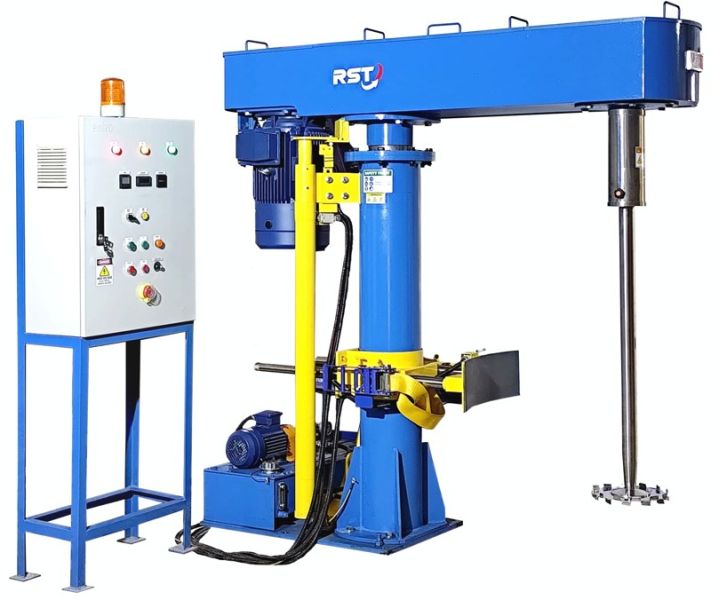
Unlike conventional agitators that primarily circulate and blend liquids, a high speed disperser is designed to generate high local shear forces around a specially designed disperser blade. These forces help break down pigment agglomerates and distribute the particles throughout the liquid phase.
An HSD is particularly suitable for premixing, pigment wetting, and high speed dispersion in formulations such as water based paint, solvent based paint, industrial coatings, and pigment concentrates.
Find more on how to choose HSD mixer for pigment dispersion.
Paint is generally a pigmented type of coating, while coating is the broader term for materials that form a functional or decorative layer on a surface. The real engineering challenge for manufacturers is controlling wetting, dispersion, mixing, viscosity, temperature, stability, and final performance — especially at the dispersion stage for pigment-based formulations.
PT Rho Sigma Trijaya designs and manufactures industrial mixing equipment for paint, ink, chemical, adhesive, building materials, food & beverage, agrochemical, and pharmaceutical applications. If you're facing dispersion, mixing time, viscosity, sedimentation, or batch consistency issues, the mixer should be evaluated together with the formulation and process conditions.
FAQ
1. Is paint the same as coating?
Not exactly. Paint is generally a type of coating, while coating is a broader term including clear, protective, decorative, and functional surface treatments.
2. Are all coatings pigmented?
No. Some coatings are clear with little or no pigment, while others are formulated with high pigment or filler loading.
3. What's the difference between paint and industrial coating?
Coating often emphasizes protective or functional performance, while paint commonly refers to pigmented formulations for color, appearance, and protection.
4. Why is dispersion important in paint manufacturing?
Proper pigment dispersion affects color development, hiding power, viscosity, gloss, storage stability, and overall consistency.
5. What mixer is commonly used for pigment dispersion?
A High Speed Disperser (HSD) is commonly used for high-shear dispersion of pigments and powders into liquid formulations, with configuration depending on formulation, viscosity, solids loading, and tank geometry.