Apa itu Agitator dan Fungsinya?
Learn what an industrial agitator is, its functions, types, benefits, and applications. Discover how to choose the right agitator for your mixing tank.
What Is an Agitator? Functions, Benefits, Types, and Industrial Applications
In industrial manufacturing, mixing is an essential process for achieving consistent product quality and uniform material distribution. Industries such as paint, ink, chemicals, food, pharmaceuticals, and adhesives rely on effective mixing systems to ensure that raw materials are properly blended.
One of the most widely used equipment in industrial mixing processes is an agitator.
What is an agitator? What are its main functions and benefits? What are the different types of industrial agitators? And how do you choose the right agitator for your production process?
This article explains the definition, working principle, functions, types, benefits, and industrial applications of agitators.
1. What Is an Agitator?
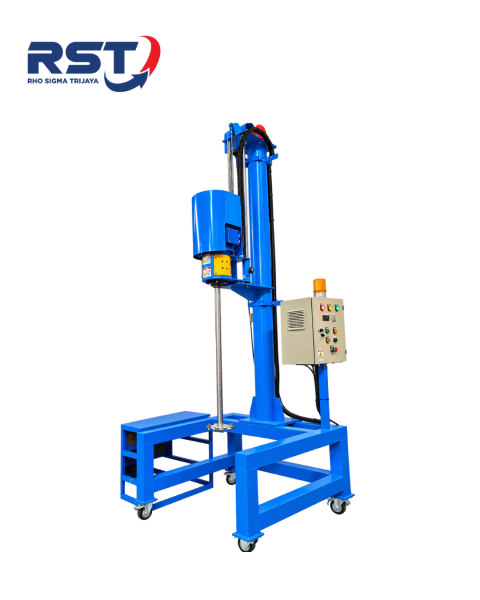
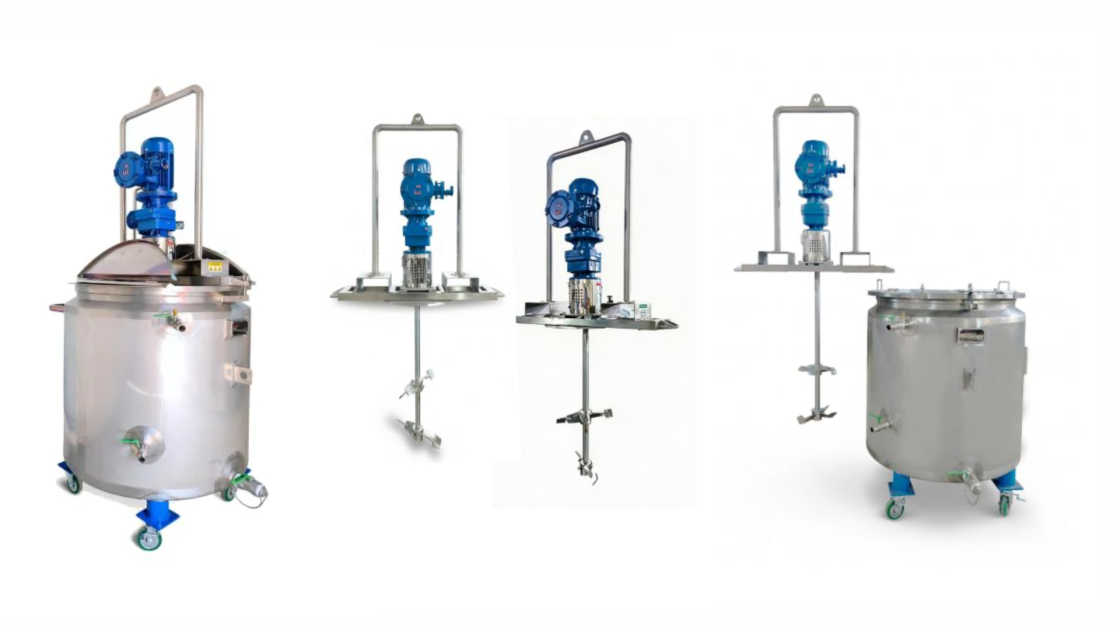
An agitator is a mechanical device designed to stir, circulate, and mix materials inside a tank or vessel using rotating impellers or blades.
An industrial agitator typically consists of an electric motor, gearbox (if required), shaft, and impeller. When the motor operates, rotational power is transferred through the shaft to the impeller, generating fluid movement inside the tank.
This movement helps blend materials, maintain product uniformity, improve dissolution, and prevent solid particles from settling at the bottom of the tank.
Industrial agitators can be designed for different material characteristics, ranging from low-viscosity liquids to highly viscous products, depending on the impeller design, rotational speed, and motor capacity.
Agitators are commonly installed in mixing tanks, storage tanks, and process vessels across various industries.
2. What Are the Main Functions of an Agitator?
Industrial agitators perform several important functions in manufacturing processes.
A. Homogenization
An agitator helps combine two or more materials to achieve a uniform mixture.
For example, water, chemicals, resins, and additives can be blended in a mixing tank during paint and coating production.
B. Dissolving
Agitators help accelerate the dissolution of powders or granular materials into liquids.
The movement generated by the impeller increases contact between the solid particles and liquid, improving the overall dissolution process.
C. Solid Suspension
In certain industrial processes, solid particles tend to settle at the bottom of a tank.
An agitator generates fluid circulation that helps keep solid particles suspended and evenly distributed throughout the liquid.
This is particularly important in applications involving pigments, fillers, and chemical suspensions.
D. Heat Transfer Improvement
In mixing tanks equipped with heating or cooling jackets, agitators help circulate the material inside the vessel.
This circulation improves temperature distribution and reduces temperature differences within the tank.
E. Maintaining Product Consistency
Agitators help maintain consistent mixing conditions throughout the production process, reducing quality variations caused by material separation or sedimentation.
3. Common Types of Industrial Agitators
The selection of an agitator depends on material viscosity, tank capacity, product characteristics, and the required mixing process.
The following are some commonly used industrial agitator types.
A. Propeller Agitator
A propeller agitator uses a blade design similar to a marine propeller to generate axial fluid flow.
Key characteristics:
Produces strong liquid circulation.
Suitable for low-viscosity liquids.
Commonly used for blending and liquid circulation.
Applications: Water treatment, chemical mixing, and low-viscosity liquid processing.
B. Turbine Agitator
A turbine agitator uses multiple blades arranged around a central hub to generate radial or combined radial and axial flow.
Key characteristics:
Generates effective turbulence.
Suitable for blending and certain gas dispersion applications.
Can be used for various industrial liquid mixing processes.
Applications: Chemical processing, coatings, and industrial liquid mixing.
C. Paddle Agitator
A paddle agitator uses flat blades rotating inside the mixing tank.
Key characteristics:
Relatively simple mechanical construction.
Generally operates at low to medium speeds.
Suitable for low to medium-viscosity materials, depending on the design.
Applications: Chemical mixing, water-based products, and liquid blending.
D. Anchor Agitator
An anchor agitator features a blade structure shaped like an anchor, following the contour of the tank wall.
Key characteristics:
Suitable for high-viscosity materials.
Creates material movement close to the tank walls.
Can be equipped with scrapers to reduce material buildup on the internal tank surface.
Applications: Adhesives, resins, gels, and other viscous products.
E. Helical Ribbon Agitator
A helical ribbon agitator uses spiral-shaped blades designed to generate axial material movement inside the tank.
Key characteristics:
Suitable for high-viscosity materials.
Promotes circulation from the bottom to the top of the tank, or vice versa.
Commonly used for thick and viscous products.
Applications: Adhesives, sealants, polymers, and other high-viscosity materials.
4. What Is the Difference Between an Agitator and a Mixer?
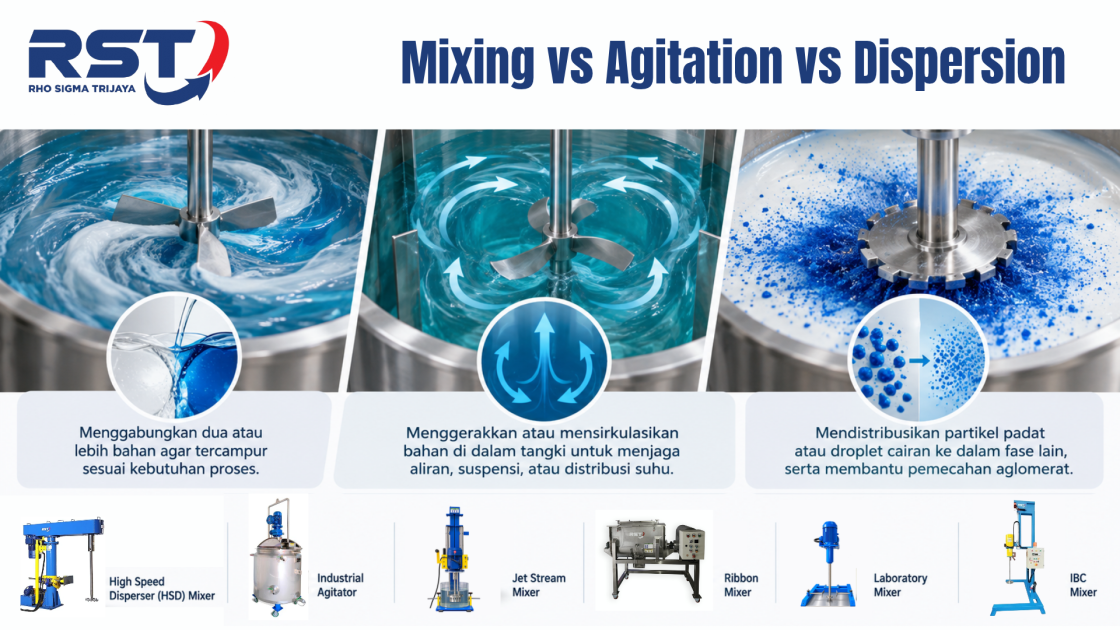
The terms agitator and mixer are often used interchangeably in industrial applications. However, they have different meanings in terms of function and equipment configuration.
In general, an agitator refers to a mechanical stirring device that generates material movement and circulation inside a tank. A mixer is a broader term that refers to the complete machine or system used to combine materials.
| Aspect | Agitator | Mixer |
|---|---|---|
| Definition | A mechanical stirring device | A mixing machine or system |
| Components | Motor, shaft, impeller | May include agitators and additional systems |
| Main function | Material movement and circulation | Combining different materials |
| Applications | Blending, suspension, circulation | Blending, dispersion, dissolving, homogenization |
In industrial applications, a mixing tank may use an agitator as its primary mixing mechanism.
However, not all mixers rely solely on conventional agitators. Some processes require additional equipment such as High Speed Dispersers, anchor systems, scrapers, or multiple impeller configurations.
5. What Are the Benefits of Using Industrial Agitators?
A properly designed agitator provides several benefits to industrial manufacturing processes.
1. Improved Production Efficiency
Effective material circulation helps accelerate the mixing process and reduces unnecessary processing time.
2. Consistent Product Quality
Uniform material distribution helps maintain product consistency from one production batch to another.
3. Reduced Sedimentation
Agitators help keep solid particles suspended, reducing the risk of material settling at the bottom of the tank.
4. Support for Industrial-Scale Production
Agitators can be customized according to tank capacity, material characteristics, and production requirements.
5. Better Process Control
With an inverter or Variable Frequency Drive (VFD), operators can adjust the agitator speed according to specific process requirements.
6. How to Choose the Right Industrial Agitator
Selecting an industrial agitator involves more than simply considering tank capacity or motor power. Several technical parameters must be evaluated.
A. Material Viscosity
Viscosity is one of the most important parameters when selecting an agitator.
Low viscosity: Propeller or turbine agitators may be suitable.
Medium viscosity: Paddle or turbine agitators can be considered.
High viscosity: Anchor or helical ribbon agitators are often more suitable.
The final selection should also consider the material's flow characteristics and mixing objectives.
B. Tank Capacity and Dimensions
Tank diameter, liquid height, bottom geometry, and working volume all influence agitator design.
C. Material Characteristics
Determine whether the material is a liquid, powder, slurry, suspension, or a combination of different ingredients.
D. Rotational Speed (RPM)
The rotational speed must be matched to the impeller type and mixing requirements. Higher RPM does not necessarily result in better mixing performance.
E. Motor and Gearbox
Motor power and gearbox ratio should be calculated based on process load, viscosity, impeller dimensions, and required operating torque.
F. Construction Material
Materials such as Stainless Steel SUS304 and SUS316L can be selected based on chemical compatibility, hygiene requirements, and operating conditions.
For specific applications, the design should also consider shaft sealing, mechanical seals, operating temperature, and safety requirements.
7. Industrial Applications of Agitators
Industrial agitators are widely used across different manufacturing sectors, each with specific mixing requirements.
| Industry | Typical Applications |
|---|---|
| Paint & Coatings | Blending resins, solvents, additives, and pigments |
| Chemical | Mixing liquid chemicals and slurries |
| Adhesives | Mixing resins, adhesives, and viscous materials |
| Food & Beverage | Blending liquid ingredients and food products |
| Pharmaceutical | Mixing solutions and formulations |
| Water Treatment | Mixing water treatment chemicals |
| Building Materials | Mixing liquid materials, slurries, and additives |
Each industry has different material characteristics and process requirements. Therefore, agitator designs must be tailored to the intended application.
8. Rho Sigma Trijaya: Industrial Agitator and Mixing Tank Manufacturer
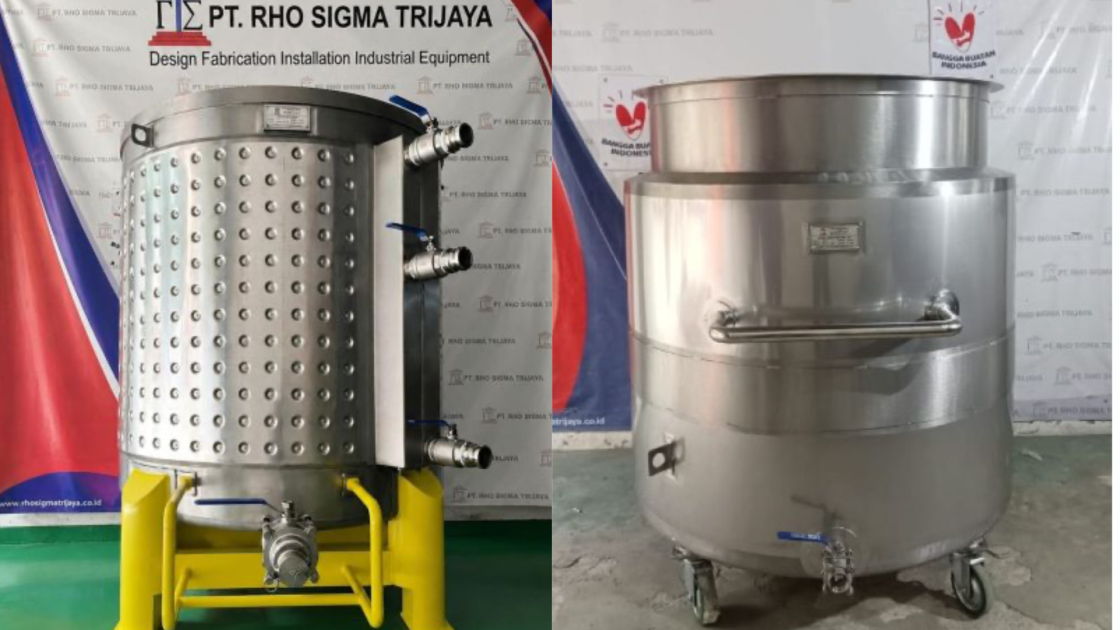
PT Rho Sigma Trijaya is an engineering and custom manufacturing company specializing in industrial mixing equipment and stainless steel tanks for various industrial applications.
RST provides customized mixing solutions designed according to material characteristics, production capacity, and specific process requirements.
Our range of mixing equipment includes:
Industrial Agitators: Mixing systems designed for specific industrial processes.
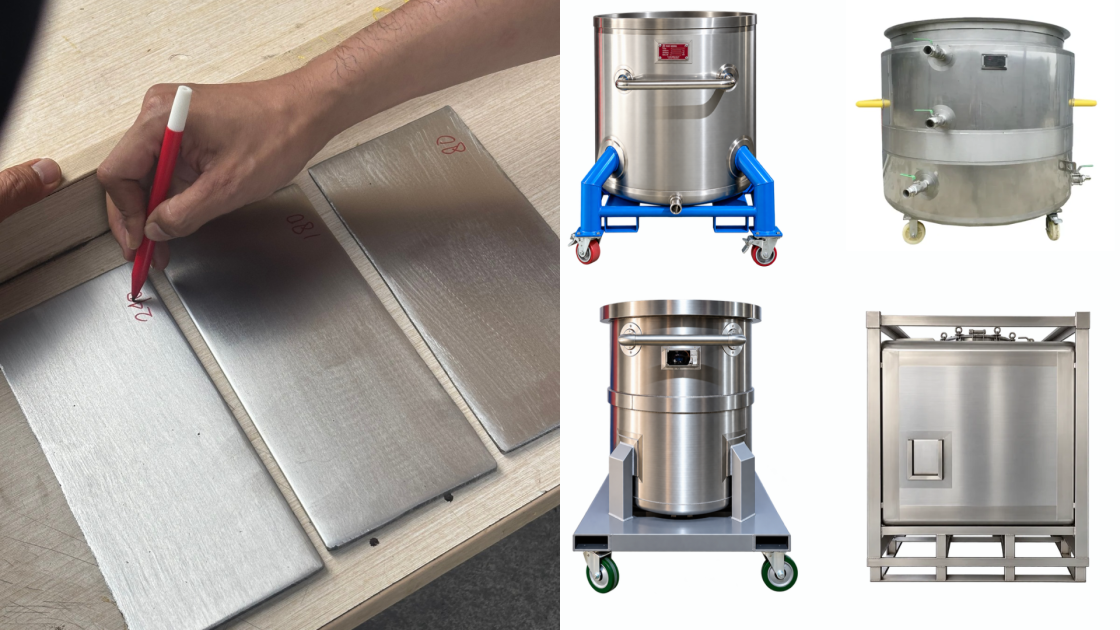
Mixing Tanks: Industrial tanks equipped with agitator systems tailored to customer requirements.
Anchor Mixers: Designed for applications involving high-viscosity materials.
Paste Mixers: Suitable for mixing paste-like materials.
High Speed Dispersers (HSD): Designed for high-speed dispersion processes in applications such as paints, inks, and coatings.
Double Jacket Tanks: Tanks equipped with heating or cooling jackets for temperature-controlled processes.
Through our custom engineering approach, equipment configurations can be developed according to customer process requirements and operating specifications.
If you are looking for an industrial agitator or a customized mixing tank, contact Rho Sigma Trijaya to discuss your application requirements.
Website: https://www.rhosigmatrijaya.co.id
Email: sales1@rhosigmatrijaya.co.id
9. Frequently Asked Questions (FAQ) About Industrial Agitators
1. What is the main function of an agitator?
The main function of an agitator is to stir and circulate materials inside a tank to support blending, homogenization, dissolution, and solid suspension processes.
2. What is the difference between an agitator and a mixer?
An agitator is a mechanical stirring device that generates material movement, while a mixer is a broader term referring to a machine or system used to combine materials.
3. Can an agitator be used for high-viscosity liquids?
Yes. Agitators can be designed for high-viscosity materials using suitable impeller configurations, such as anchor or helical ribbon designs. The selection must consider actual viscosity, operating torque, and material flow characteristics.
4. What is the ideal RPM for an industrial agitator?
There is no single RPM suitable for all agitators. The ideal rotational speed depends on the impeller type, tank dimensions, material viscosity, and mixing objectives.
5. What materials are commonly used to manufacture industrial agitators?
Common construction materials include Stainless Steel SUS304 and SUS316L. The selection depends on chemical compatibility, material characteristics, and hygiene requirements.
6. Can an agitator be installed in a mixing tank?
Yes. An agitator is commonly installed in mixing tanks as the primary stirring mechanism. Its configuration is customized according to tank capacity and process requirements.
7. Can an industrial agitator use an inverter?
Yes. A Variable Frequency Drive (VFD) can control motor speed, allowing operators to adjust agitator RPM according to production requirements.
8. How do you determine the required motor power for an agitator?
Motor power is determined by considering material viscosity, tank dimensions, impeller diameter, rotational speed, material density, and the required operating torque.
Conclusion
An industrial agitator is an essential component of industrial mixing systems. It generates material movement and circulation inside tanks to support efficient and consistent mixing processes.
Selecting the right agitator helps improve production efficiency, maintain product consistency, and achieve the required mixing performance.
For optimal results, agitator design must consider material characteristics, viscosity, tank capacity, impeller type, rotational speed, and motor power requirements.
If your company requires an industrial agitator or a customized mixing tank, Rho Sigma Trijaya is ready to support your industrial mixing requirements with customized engineering solutions.